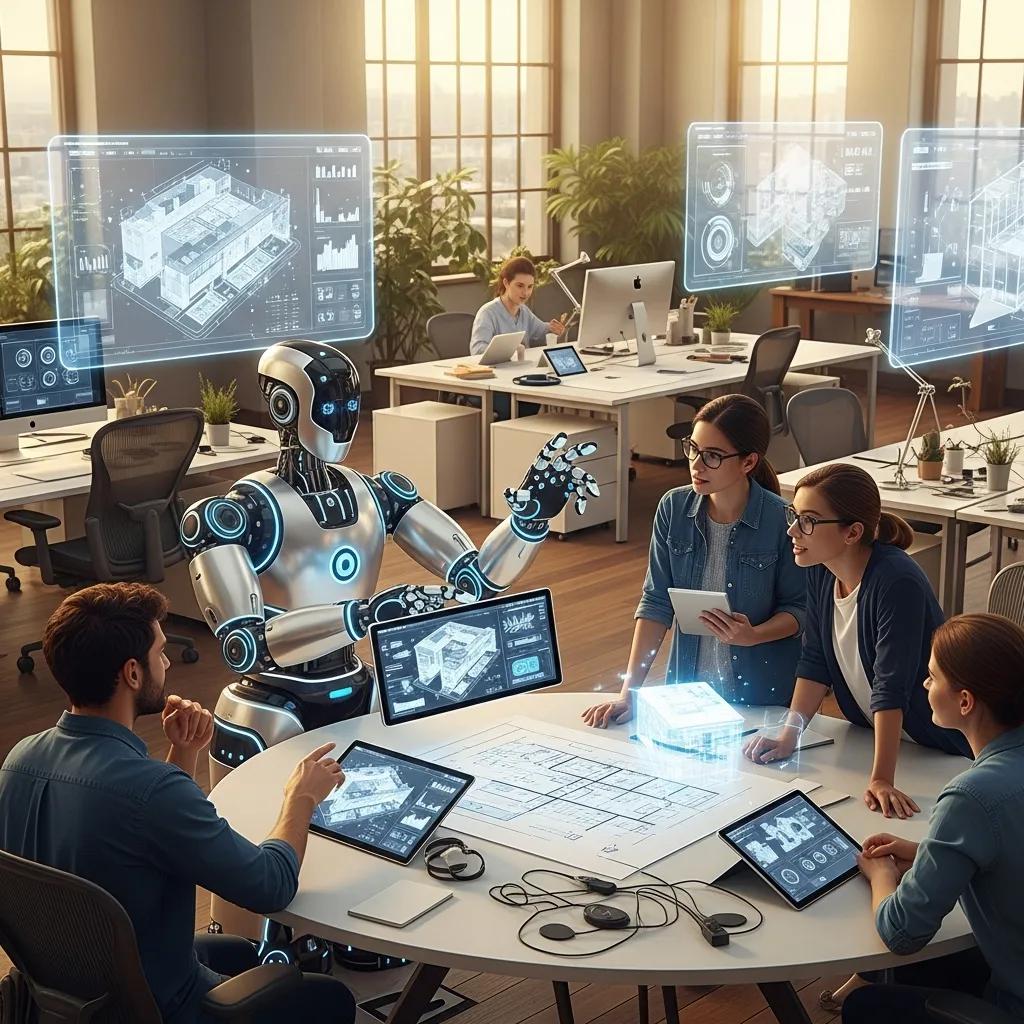
AI Robotics Solutions: A Practical Guide to Intelligent Machines and Emerging AI
AI and robotics are reshaping industries—boosting efficiency, cutting costs, and changing how people and machines work together. In this guide we break down how AI-powered robots operate, the technologies that enable them, and the ways organisations are using them today. You’ll find practical explanations of machine learning, computer vision, and natural language tools, plus a look at how platforms like Google Cloud AI accelerate real-world deployments. We also cover common use cases, emerging trends, and the challenges teams face when adopting these systems.
This article is written for technical leaders, engineers, and operational managers who are evaluating or building AI-enabled robotic systems. It balances conceptual background with practical considerations—such as integration patterns, data pipelines, and safety practices—so you can map ideas to implementation choices in your environment.
What are artificial intelligence robots, and how do they work?
Artificial intelligencerobots combine mechanical systems with software that senses, decides, and acts. Depending on their design, they operate autonomously or alongside people—using machine learning, computer vision, and natural language processing to interpret inputs, make choices, and respond to changing conditions. The main advantage is clear: AI robots increase throughput and consistency across tasks from factory floors to clinical settings.
Practically speaking, an AI robotsystem ties together sensors (cameras, LiDAR, force sensors), actuators (motors, grippers), a real-time control loop, and one or more AI models. Safety systems and supervisory controls run in parallel to ensure predictable behaviour. Teams building these systemsdesign for different autonomy levels—teleoperated, semi-autonomous, and fully autonomous—each with distinct testing and verification needs.
Defining AI robotics: concepts and core technologies
AI robotics is an umbrella for technologies that give machines situational awareness and decision-making ability. Core elements include:
- Machine Learning: Algorithms that let robots improve with data—adapting behavior over time without explicit reprogramming.
- ComputerVision: Systems that translate camera and sensor input into usable scene understanding for navigation, inspection, and interaction.
- Natural Language Processing: Tools that let robots parse and generate humanlanguage for more natural interactions.
Together these building blocks let robots handle complex tasks and adjust to new conditions without constant human intervention.
Under the hood, most AI-robotics stacks include perception modules (for sensing), state estimation and mapping, planning and decision modules, and execution controllers. These components communicate through middleware or message buses and are often wrapped with monitoring, logging, and health-check services so teams can observe performance and diagnose faults in production.
How machine learning and computer vision enable intelligent automation
Machine learning and computer vision are central to smarter automation. ML models spot patterns and predict outcomes from large datasets, enabling real-time optimisations—like scheduling maintenance before a failure. Computer vision adds a visual layer, letting robots inspect parts, detect defects, and verify quality with precision. When combined, these technologies reduce downtime, improve accuracy, and unlock automation that adapts as conditions change.
Implementing ML and vision in robotics requires attention to data quality, annotation consistency, and model lifecycle management. Many teams use simulated environments for initial training and then refine models with real-world telemetry collected during controlled runs. Continuous evaluation and retraining pipelines keep models robust as lighting, wear, and operational profiles evolve.
How does Google Cloud AI support robotics innovation?

Google Cloud AI offers a set of managed tools and APIs that help teams build, train, and deploy the machine learning components robots rely on. From model training to scalable inference and prebuilt vision and language APIs, these services shorten development cycles and simplify production deployments.
In practice, teams combine cloud-hosted model training and experiment tracking with on-device or edge inference for low-latency decision-making. Cloud services handle heavy compute and versioned model artifacts, while edge nodes or gateways run optimised runtimes that meet real-time constraints. Secure data flows, access controls, and encryption are typical concerns when moving telemetry and models between robot fleets and cloud infrastructure.
Exploring Google Cloud AI services for robotics development
- AI Platform: A managed environment to build, train, and serve ML models at scale.
- Vision AI: Image analysis and object detection services that help robots interpret visual scenes reliably.
- Natural LanguageAI: Tools for parsing and generating text, enabling more intuitive voice or chat interactions.
These services let developers focus on robot behaviour while offloading heavy lifting—training, scaling, and model serving—to a cloud platform.
When choosing which services to use, consider latency, privacy, and update cadence. For example, perception models that require millisecond responses are often deployed at the edge, while analytical models that aggregate fleet-wide telemetry run in the cloud. Proper CI/CD for models, canary deployments, and rollback paths are important best practices when iterating on production robot behaviours.
Case studies: successful AI robotics solutions using Google Cloud
Organisations across sectors have leveraged Google Cloud AI to deliver measurable results. One logistics operator used the AI Platform to build predictive maintenance for delivery drones, cutting operational costs by roughly 20–30% and improving schedule reliability. A healthcare provider applied Vision AI to patient-monitoring workflows, boosting early detection and streamlining staff workflows. These examples show how cloud-backed AI accelerates practical robotics deployments.
Across these projects common success factors emerge: clear problem definition, close collaboration between ML engineers and domain experts, robust data collection processes, and phased rollouts that de-risk production behaviour. Teams that combine cloud-hosted experimentation with strong on-device safety checks tend to scale their fleets with fewer interruptions.
Building on predictive maintenance and autonomous systems, recent research demonstrates how robotics can transform solar-panel upkeep.
AI Robotics for Solar Panel Maintenance & Predictive Analytics
This study presents an AI-integrated autonomous robotic system that combines continuous monitoring, predictive analytics, and intelligent cleaning to improve solar-panel performance. The authors developed a hybrid approach using CNN-LSTM models for fault detection, DQN-based reinforcement learning to guide robotic cleaning, and Edge AI analytics for low-latency decisions. Thermal and LiDAR-equipped drones identify panel faults while ground robots perform cleaning based on real-time dust and temperature data. By integrating AI, robotics, and edge computing, the system increases energy yield, lowers manual labour, and offers a scalable model for resilient solar infrastructure.
AI-Integrated autonomous robotics for solar panel cleaning and predictive maintenance using drone and ground-based systems, I Kishor, 2025
What are the leading applications of AI-powered robots across industries?
AI-powered robots are already delivering value in many sectors—improving throughput, accuracy, and safety. Their use cases span manufacturing lines, warehouses, clinics, and farms, each tailored to specific operational goals.
While applications differ by domain, many share architectural patterns: perception pipelines that fuse multiple sensors, planners that balance efficiency and safety, and remote monitoring consoles for human operators. Reusable components and modular software help organisations adapt solutions to new tasks without rebuilding core logic.
AI robots in manufacturing, logistics, and autonomous vehicles
In manufacturing, robots handle assembly, welding, and inspection with high repeatability, increasing production speed and reducing defects. In logistics, autonomous vehicles and mobile robots navigate warehouses to move goods efficiently, optimise inventory flow, and cut manual handling. These systems also reduce exposure to hazardous tasks, improving workplace safety.
A typical quality-inspection workflow uses a vision model to detect surface defects and a downstream classifier to prioritise rework. Integrating that pipeline with production scheduling systems ensures that flagged parts are routed appropriately without human delay, demonstrating how perception and orchestration combine to deliver operational value.
Healthcare robotics and service robots powered by AI
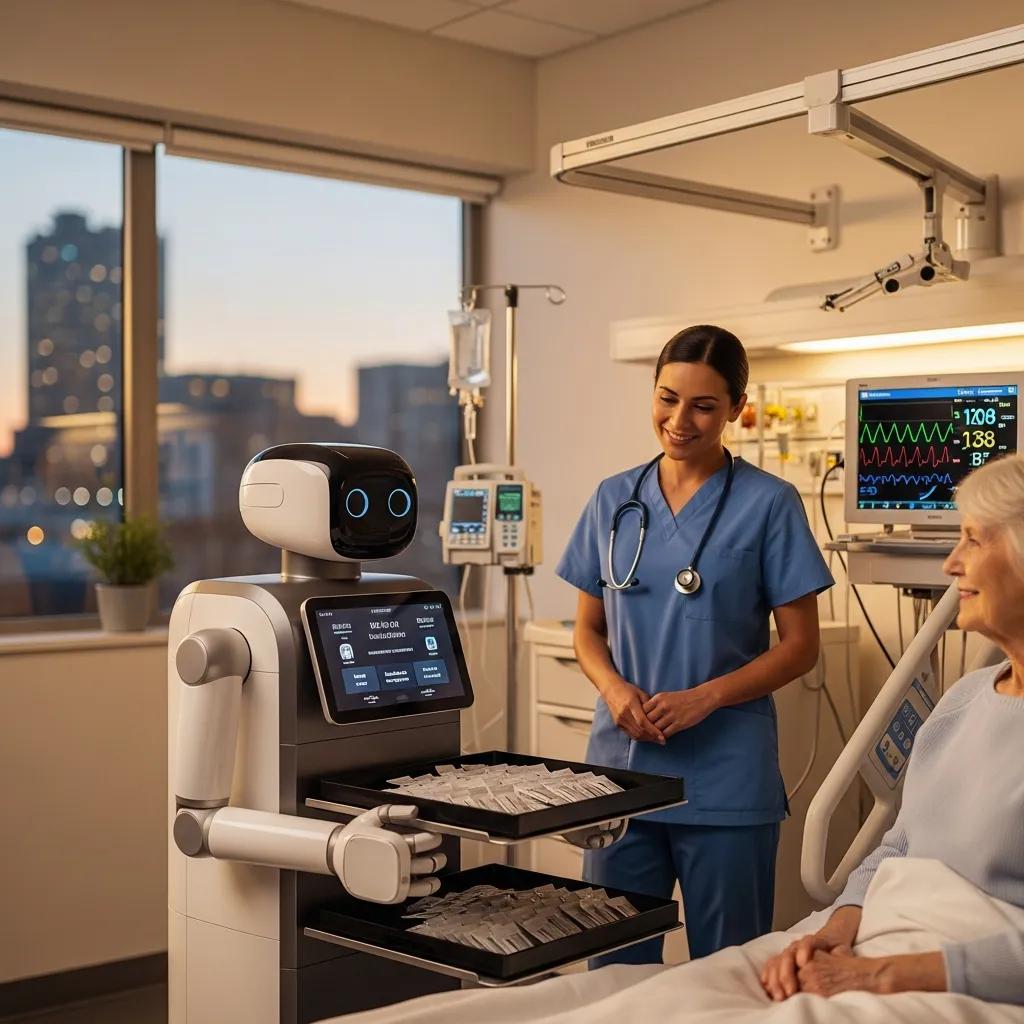
Healthcare robotics range from surgical systems that increase precision to service robots that deliver medication and monitor patients. These technologies help clinicians work more effectively, shorten recovery times for patients, and free staff for higher-value clinical tasks.
Deployments in clinical environments add layers of regulatory, privacy, and integration concerns. Systems must interoperate with electronic health records, respect patient consent and data minimisation principles, and follow local clinical governance processes. Trial phases with clinician feedback loops help refine behaviour and user experience before broad rollouts.
What is the future of AI in robotics and intelligent automation systems?
The trajectory for AI in robotics points toward more capable, collaborative, and context-aware machines. Advances in materials, sensing, and learning algorithms will expand where and how robots operate.
Looking ahead, modularity and standardised interfaces will make it easier to assemble capabilities from different vendors, while advances in low-power compute will extend on-device intelligence. Progress will be incremental: systems will gain new skills through improved perception, safer planning, and better human–robot interaction primitives.
Emerging trends in physical AI and humanoid robot development
Physical AI and humanoid platforms are maturing: better actuators and sensors yield smoother motion and richer interactions. Expect growth in customer-facing roles, collaborative assistants, and robots that can interpret basic human cues. As capabilities improve, robots will participate in more everyday tasks while partnering with humans in shared workflows.
Developers are investing in more natural interaction models and safety-aware motion planning so robots can work closer to people. These trends lower barriers for deployment in retail, hospitality, and services where human comfort and predictable behaviour are paramount.
Ethical considerations and societal impact of AI robotics
Wider adoption brings questions about jobs, privacy, and algorithmic fairness. Addressing potential displacement, ensuring transparent data practices, and mitigating bias in models are essential steps. Policymakers, technologists, and organisations need to collaborate so benefits are broad and harms are minimised.
Practical measures include stakeholder engagement, impact assessments, and audits of training data and model outputs. Workforce transition plans that include retraining, role redesign, and clear communication help organisations realise productivity gains while supporting affected employees.
How do intelligent automation systems enhance productivity and safety?
Intelligent automation—where AI informs robotic action—boosts both output and safety. By automating repetitive or dangerous tasks, these systems let people focus on complex, creative, or supervisory work.
Measured improvements typically follow a lifecycle: pilot an automation for a clearly scoped process, validate safety and performance under controlled conditions, integrate with operations, and iterate on edge cases. Over time this approach reduces incidents and stabilises throughput while enabling staff to work on higher-value activities.
Integration of AI and robotics for smart factory automation
Smart factories connect sensors, machines, and analytics to continuously optimise production. Real-time data and AI-driven control reduce waste, balance throughput, and enable predictive maintenance so equipment runs reliably at peak efficiency.
Orchestration layers and digital twins help teams simulate changes before applying them to live lines. By modelling equipment behaviour and control flows, organisations can test scheduling strategies, validate safety constraints, and forecast the production impact of software updates without disrupting ongoing operations.
Improving worker safety and precision with AI-driven robotics
Robots take on heavy, hazardous, or ergonomically risky tasks, lowering injury rates. At the same time, AI increases precision in operations like assembly and inspection—leading to fewer defects and safer end products.
Safety systems often combine hard stops, geofencing, force limits, and vision-based person detection. These layered protections ensure that when unexpected conditions arise, the system defaults to a safe state and alerts human supervisors for intervention.
What are the key challenges and innovations in robotics innovation AI?
Despite rapid progress, several obstacles remain. Technical limitations, governance gaps, and deployment complexity must be addressed before robotics reach their full potential.
Operationalising research prototypes into resilient, maintainable systems requires investments in tooling, observability, and processes that support long-term model maintenance. Organisations that plan for data drift, hardware lifecycle, and cross-team ownership are better positioned to scale robotics initiatives.
Technical challenges in developing advanced AI robotics
Key technical hurdles include improving model robustness, increasing sensor fidelity, and ensuring resilient, low-latency communication between robots and control systems. Solving these challenges is critical for dependable operation in unpredictable environments.
Other practical hurdles include latency budgeting for perception-to-action loops, calibration and synchronization of heterogeneous sensors, and designing fail-safe behaviours that are understandable to operators. Good engineering practices—such as modular testing, hardware-in-the-loop simulations, and staged rollouts—help reduce deployment risk.
Breakthroughs from Google AI and DeepMind in robotics research
Groups like Google AI and DeepMind are advancing reinforcement learning, transfer learning, and simulation-to-reality techniques that speed up robotlearning and decision-making. Their research is helping robots learn complex behaviors with less human supervision and greater adaptability.
Translating lab advances into products typically involves engineering work to constrain models, provide interpretability, and integrate with real-time control systems. Open collaborations between research teams and engineering groups accelerate this process by sharing benchmarks, tooling, and simulation environments.
Frequently Asked Questions
What industries are most impacted by AI robotics?
AI robotics is reshaping manufacturing, healthcare, logistics, and agriculture most visibly. Manufacturers gain speed and quality control; healthsystems benefit from surgical and service automation; logistics uses autonomous vehicles and mobile robots to streamline supply chains; and agriculture applies robotics for planting, harvesting, and crop monitoring—raising yields while lowering labour costs. Each sector adapts these tools to its own operational needs.
Smaller sectors and niche operations also see gains when solutions are tailored to specific workflows. The common thread is that repetitive physical tasks with measurable KPIs are prime candidates for early automation.
How do AI robots ensure safety in the workplace?
AI robots improve safety by taking on hazardous tasks and continuously monitoring conditions. They can lift heavy loads, handle toxic materials, or operate in dangerous environments—while sensors and software detect unsafe conditions and alert human supervisors. The result is fewer accidents and a safer environment for workers.
Safety is achieved through both design and runtime controls: rigorous hazard analysis during development, redundant sensing, conservative motion planning, and clear operator interfaces for intervention. Regular drills and maintenance schedules keep safety features reliable.
What role does data play in the effectiveness of AI robotics?
Data is the foundation of AI-driven robots. Large, well-labelled datasets enable models to recognise patterns, predict failures, and adapt behaviour. Continuous telemetry from machines and sensors helps robots refine their performance over time, making operations more efficient and reliable.
Effective data practices include consistent labelling standards, versioned datasets, and synthetic data augmentation when real-world examples are rare. Observability pipelines that capture inputs, model outputs, and outcomes are essential for diagnosing failures and improving models iteratively.
What are the ethical concerns surrounding AI robotics?
Ethical concerns include potential job displacement, privacy risks from pervasive sensing, and bias in algorithmic decisions. Addressing these issues requires clear governance, transparent data practices, and inclusive design to ensure systems serve broad societal interests.
Governance measures can include independent audits, clear accountability for decisions made by automated systems, and mechanisms for human oversight and contestability. Engaging affected communities during design helps surface risks early and build trust.
How can businesses implement AI robotics solutions effectively?
Start with clear objectives and a process audit to identify high-value automation opportunities. Partner with experienced providers (for example, platforms like Google Cloud AI) for infrastructure and tooling, invest in workforce training, and deploy incrementally so you can learn and adjust from real-world feedback.
Operational guidance: prototype quickly on a narrow use case, validate performance under realistic conditions, define success metrics, and plan phased rollouts. Include maintenance and data pipelines in your budget and roadmap so models remain accurate and hardware stays serviceable.
What future trends should we expect in AI robotics?
Look for advances in physical AI, more capable humanoid and collaborative robots (cobots), and tighter integration with IoT ecosystems. These trends will enable robots to operate more autonomously and work more closely with humans across a wider range of tasks.
Expect improved tooling for end-to-end development, stronger safety standards, and wider availability of pre-trained models that teams can adapt to their domains. Together these developments will lower barriers to entry and accelerate practical deployments.
Conclusion
AI robotics is transforming how organisations operate—delivering higher efficiency, better quality, and safer workplaces. By combining machine learning, computer vision, and cloud services, businesses can unlock new levels of automation. If you’re exploring adoption, start with targeted pilots, measure outcomes, and scale what works. Explore our resources to find practical next steps for bringing AI robotics into your organisation.
Checklist to get started: identify a bounded high-impact use case, collect and label representative data, run a controlled pilot with clear safety protocols, instrument observability for models and hardware, and plan incremental scaling with training for staff. Adopting these practices helps teams turn prototypes into reliable, maintainable systems that deliver measurable value.
Leave a Reply