
What is Software Quality Assurance? Definition, Process, Benefits, and Importance
Software Quality Assurance (SQA) is a disciplined, process-oriented approach that ensures software products meet defined quality standards by preventing defects across the software development lifecycle. It works by establishing repeatable processes, standards, and measurements that guide requirements, design, development, testing, and release activities to reduce defects, lower remediation costs, and increase reliability. This article explains SQA’s core principles, the PDCA-based SQA process, how SQA differs from quality control and testing, and the measurable benefits and common challenges organizations face when adopting SQA practices. Readers will find practical guidance for creating an SQA plan, checklists to prioritize SQA work, and concrete techniques — from code review and static analysis to CI/CD quality gates, risk-based testing, and emerging approaches like AI-powered testing and chaos engineering. The following sections map fundamentals and objectives, walk through lifecycle activities, compare SQA to QC and testing, outline benefits and mitigations, detail essential methodologies and tools, and summarize the standards and tool categories that support effective SQA practices.
What is Software Quality Assurance? Definition, Principles, and Core Objectives
Software Quality Assurance (SQA) is the set of organizational processes and controls designed to ensure that software development and maintenance activities consistently produce products that satisfy stakeholder requirements and regulatory standards. SQA operates by embedding prevention-focused controls — such as process definition, audits, and metrics — into the SDLC so problems are detected earlier and fewer defects reach production. The primary objectives are to enforce standards, prevent defects, verify compliance, and drive continuous improvement in process capability and product quality. These objectives rely on measurement, feedback loops, and accountability to align engineering practices with business and regulatory expectations while reducing rework and customer-impacting issues.
What are the key principles and goals of SQA?
SQA is grounded in a concise set of principles that translate policy into repeatable engineering practices and measurable outcomes. Prevention is central: SQA prioritizes activities that stop defects from being introduced, such as requirements reviews and coding standards. Continuous improvement follows, using metrics and retrospectives to refine processes and tooling. Standardization ensures consistency through templates, checklists, and documented procedures. Measurement and traceability provide objective evidence of quality via metrics like defect density, test coverage, and escaped defects. Accountability assigns roles for quality ownership, from process stewards to release managers. Together these principles enable SQA teams to convert quality goals into concrete process steps and measurable targets that lower the cost of defects over time.
Why is SQA important in software development?
SQA delivers both technical and business value by reducing defects, accelerating delivery through predictable processes, and ensuring regulatory or contractual compliance. Early defect detection through SQA activities dramatically decreases remediation costs compared with fixing issues in production, and it shortens time-to-market by avoiding late-stage rework. Improved reliability and security from disciplined SQA practices increase customer trust and reduce support costs. Organizations also gain governance benefits: documented SQA processes make audits and certifications feasible and support continuous process improvement across teams. These outcomes create a quantifiable ROI when SQA is integrated with development practices and measured consistently.
What are the main steps in the SQA process? A detailed guide to SQA lifecycle and activities
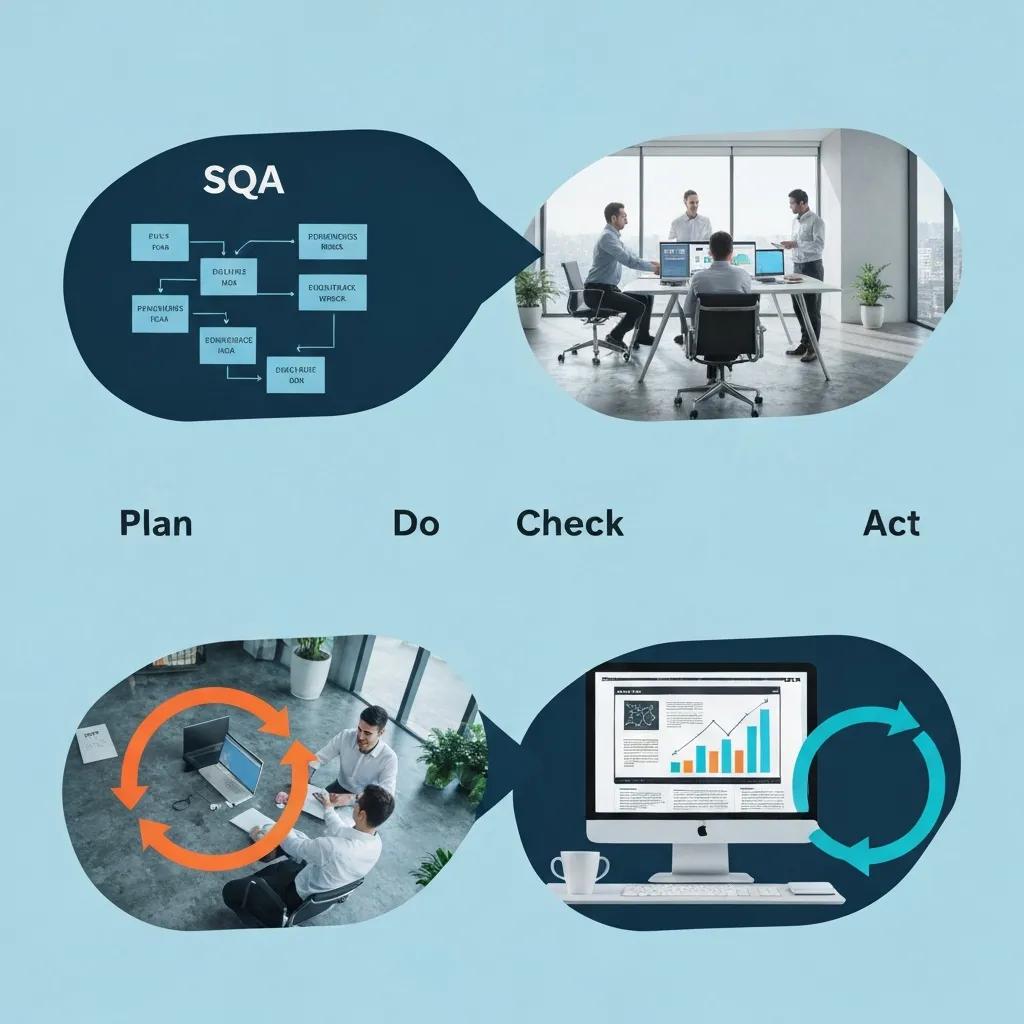
The SQA process follows a Plan-Do-Check-Act (PDCA) cycle tailored to software delivery, combining upfront planning, disciplined execution, verification, and continuous improvement to maintain and increase quality. Planning defines scope, standards, roles, tools, and exit criteria; the Do phase implements development and testing activities consistent with the plan; Check uses metrics, audits, and reviews to validate adherence and product quality; Act applies lessons learned and corrective actions to close gaps. This lifecycle integrates requirements analysis, test planning, code reviews, automated and manual testing, defect triage, and release governance into a repeatable quality workflow that feeds continuous improvement.
What are the four essential steps of quality assurance?
The PDCA steps provide a clear operational structure for SQA programs and each step includes specific tasks and checkpoints. Plan involves scoping the SQA plan, defining acceptance and exit criteria, selecting standards (e.g., coding rules, security baselines), and identifying tools and roles. Do covers development practices, implementation of unit/integration tests, static analysis, and continuous integration pipelines that enforce quality gates. Check performs verification through test execution, audits, peer reviews, and metrics analysis like test pass rate and defect trends. Act mandates corrective actions, process updates, training, and retrospective reviews that close the loop and raise process maturity for subsequent cycles.
- Plan: Define standards, scope, roles, tools, metrics, and exit criteria.
- Do: Implement development, testing, automation, and code quality checks.
- Check: Execute tests, audits, and reviews; collect and analyze quality metrics.
- Act: Apply corrective measures, update processes, and institutionalize improvements.
These four steps form a continuous cycle that reduces defect leakage and increases predictability in delivery. Effective SQA plans explicitly map tasks and gates to each PDCA stage so teams can measure compliance and improvement over time.
PDCA Cycle: A Framework for Quality Management in Projects
Quality Management rules, the work on the project was based on team-work and modelled on the PDCA cycle, also called the Deming cycle. The PDCA cycle is a four-step management method used in business for the control and continuous improvement of processes and products. It is also known as the Shewhart cycle, or plan–do–check–act.
How is SQA integrated into different SDLC models like Waterfall, Agile, and DevOps?
SQA adapts to SDLC models by matching controls to cadence and responsibilities while preserving prevention and measurement. In Waterfall, SQA manifests as formal checkpoints, document-driven reviews, and phase-gate testing that verify compliance at defined milestones. Agile shifts SQA left: quality practices such as automated unit tests, acceptance criteria, and continuous integration are embedded within sprints and done incrementally. DevOps emphasizes continuous assurance with CI/CD pipelines, automated quality gates, production telemetry, and rapid feedback loops that treat operational resilience as part of SQA. Across all models, the balance of automation, checkpoints, and governance is tuned to cadence: more formal controls in waterfall, iterative embedded practices in Agile, and pipeline-driven automation in DevOps.
How does Software Quality Assurance differ from Quality Control and Software Testing?
SQA, Quality Control (QC), and software testing are related but distinct facets of ensuring software quality: SQA focuses on establishing and improving processes, QC inspects products against standards, and testing executes specific techniques to find defects. SQA is organizational and preventive, setting up the methods and standards; QC is product-oriented and corrective, verifying the product meets quality criteria through inspections and acceptance activities; testing is the operational act of executing test cases (unit, integration, system, acceptance) to detect defects. Understanding these boundaries helps organizations allocate responsibilities and measure outcomes across governance, verification, and execution.
What is the difference between SQA and Quality Control?
SQA establishes the process framework, standards, and measurement systems that aim to prevent defects, while QC performs inspections and product checks that detect defects before release. SQA activities include process audits, training, standards definition, and metrics collection; QC activities include test execution, code inspections, and acceptance verification. While QC identifies product-level issues and feeds defects back into development, SQA evaluates whether processes enabled by the organization are effective and prescribes systemic changes. Both disciplines are complementary: QC supplies evidence about product quality, and SQA uses that evidence to prevent future defects.
How does SQA compare to software testing?
Software testing is a practical execution discipline within QC and SQA that applies techniques like unit testing, integration testing, system testing, and acceptance testing to validate functionality and find defects. SQA governs testing by defining test standards, coverage criteria, exit criteria, and metrics that determine whether testing is sufficient. For example, SQA may mandate minimum code coverage thresholds, required static analysis rules, or definition of done criteria that shape test strategy. Testing provides the empirical data (found defects, pass rates) while SQA ensures those test activities align with broader quality objectives and process controls.
What are the benefits and challenges of implementing SQA?
Implementing SQA delivers measurable benefits—reduced defect rates, lower remediation costs, improved customer satisfaction, and regulatory compliance—while posing challenges such as initial overhead, cultural resistance, and tooling complexity. By combining standards, automation, and targeted governance, SQA reduces long-term costs and increases product reliability. However, organizations must manage upfront investments in training, tooling, and process change and prioritize interventions using risk-based approaches to avoid excessive overhead. Effective mitigation strategies include incremental rollouts, automation to reduce manual effort, executive sponsorship for cultural change, and aligning SQA metrics to business outcomes.
What are the key benefits of SQA for software projects?
SQA produces several quantifiable and strategic advantages that justify investment when applied consistently. It decreases the cost of defects by shifting detection earlier in the lifecycle; early defect discovery can cut remediation cost by an order of magnitude compared with post-release fixes. SQA improves reliability and uptime, which strengthens customer trust and reduces support burden. It supports compliance with industry standards and makes audits and certification practical. These benefits together increase the predictability of delivery and can demonstrate measurable ROI when organizations track indicators like escaped defects, mean time to repair, and defect trend improvements.
Key SQA benefits include:
- Reduced defect remediation costs due to early detection.
- Higher product reliability and customer satisfaction through consistent quality.
- Better regulatory and contractual compliance enabled by documented processes.
Measured benefits become clearer when teams track quality metrics and map them to business outcomes, enabling targeted investments and continuous improvement.
Software Quality Assurance: Applying Universal Principles to Development
Software quality assurance (SQA) or, in other words, can we not use the general quality assurance methods and techniques that are already developed and used in manufacturing and other industries? Having decided to develop specialized books for software quality assurance, at the same time, we must acknowledge that the principles and methods of quality assurance are universal and can be applied to software development.
| Benefit/Challenge | Cause | Impact / Mitigation |
|---|---|---|
| Reduced remediation cost | Early defect detection through reviews and automation | Lowers total cost-of-quality; mitigate by investing in test automation and static analysis |
| Increased reliability | Standardized processes and quality gates | Improves customer trust; mitigate by defining clear exit criteria |
| Overhead and resource needs | Initial tooling and training | Can slow teams early; mitigate with phased rollout and automation |
| Cultural resistance | Process changes and perceived bureaucracy | Reduces adoption; mitigate with executive sponsorship and role-based training |
What challenges and limitations can organizations face with SQA?
Organizations frequently encounter constraints such as perceived overhead, inadequate skills, and the complexity of selecting and integrating tools. SQA can be mischaracterized as bureaucratic unless it demonstrably accelerates value delivery; teams may resist if processes feel prescriptive without clear benefits. Tool proliferation increases integration and maintenance costs, while keeping standards and tooling current requires dedicated stewardship. Mitigations include prioritizing high-impact controls, using risk-based testing to focus on critical areas, adopting incremental automation to reduce manual burden, and providing continuous training and coaching to embed quality ownership across teams.
What are the essential methodologies and techniques used in SQA?
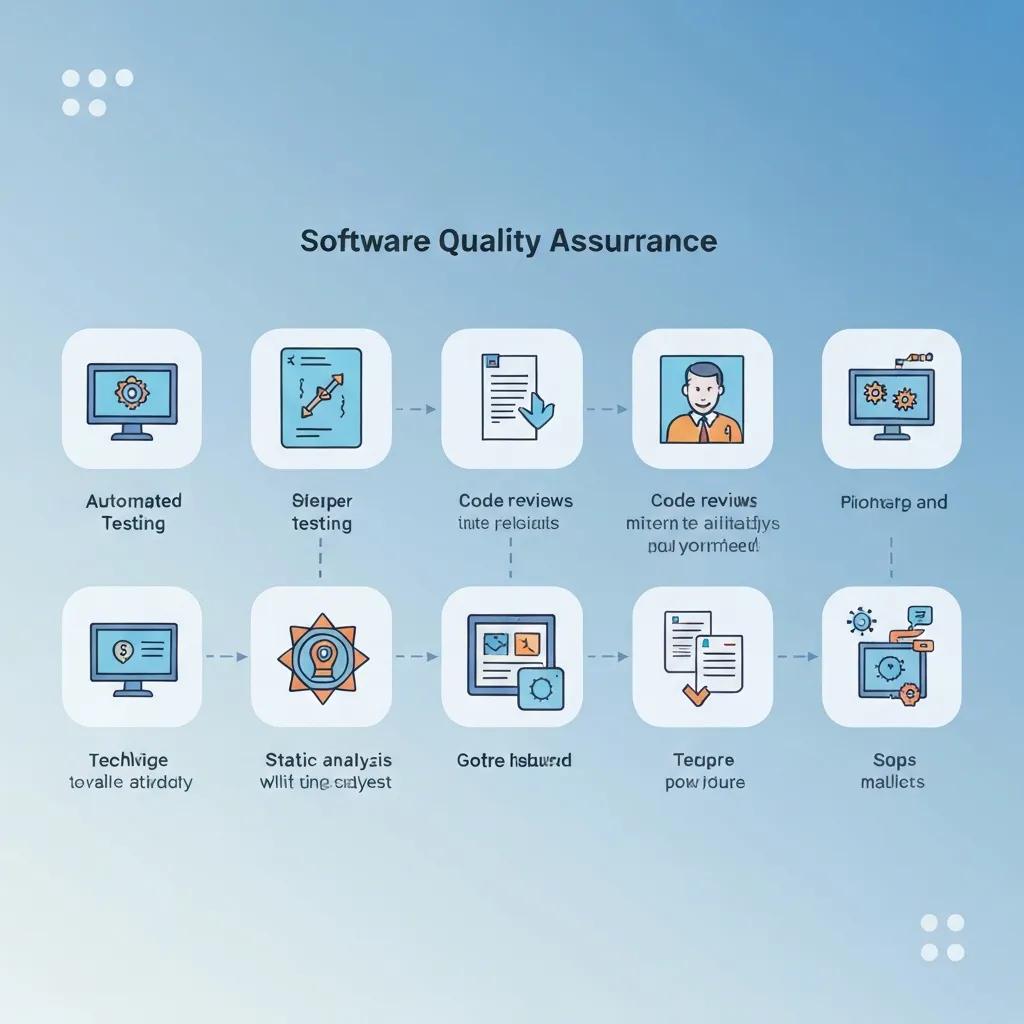
SQA relies on a complement of techniques — code review, automated testing, static analysis, CI/CD quality gates, test-driven development (TDD), risk-based testing, performance and security testing — each delivering specific quality mechanisms and outcomes. These techniques work together: static analysis prevents common defects early, code review catches architectural and logic issues while spreading knowledge, automated tests provide regression protection within CI/CD pipelines, and risk-based testing ensures scarce manual testing effort focuses on the highest-impact areas. Combining techniques yields a layered defense that reduces defect leakage and improves maintainability.
How do code reviews, automated testing, and static analysis improve software quality?
Code reviews, automated testing, and static analysis form a complementary trio that addresses different defect classes and knowledge transfer. Code reviews provide human insight into design, readability, and edge cases while distributing domain expertise across the team. Automated testing (unit, integration, UI) ensures regressions are caught quickly and enables safe refactoring by verifying behavior in CI pipelines. Static analysis enforces coding standards, detects security vulnerabilities and maintainability issues at commit time, and prevents classes of defects before runtime. Best practice is to integrate static analysis and automated tests into pull request pipelines, and to treat code review as both a defect detection and knowledge-sharing mechanism.
Quick adoption checklist:
- Integrate static analysis in pre-commit or PR checks.
- Require automated unit tests with CI validation.
- Use code review templates to cover architecture, testing, and security.
These tactics reduce escape rates and raise the baseline quality of delivered code.
| Technique | Primary Use | Typical Outcome |
|---|---|---|
| Automated Testing | Regression and CI validation | Faster feedback, consistent verification |
| Static Analysis | Code quality and security checks | Early detection of vulnerabilities and maintainability issues |
| Code Review | Design and correctness validation | Reduced logic defects and knowledge sharing |
| TDD | Design by tests, early coverage | Better designability and test-first discipline |
| Risk-based Testing | Prioritization of test effort | Focuses testing on highest-impact areas |
What role do CI/CD, risk-based testing, and test-driven development play in SQA?
CI/CD, risk-based testing, and TDD are foundational for continuous quality and prioritization. CI/CD automates build, test, and deployment pipelines and enforces quality gates that prevent regressions from progressing; these pipelines operationalize SQA by making checks repeatable and fast. Risk-based testing allocates manual and exploratory testing to the highest-risk features or modules, ensuring limited human effort yields maximal defect-finding value. TDD embeds tests in the design phase, improving test coverage and producing code that is inherently testable. Together they provide a pragmatic balance of automation, prioritization, and design discipline that scales SQA across frequent releases.
PDCA Cycle for Software Testing Process Improvement
At the implementation stage, the software testing team analyzes the collected measurement data and their internal relationship using one or several quality management tools, including the PDCA cycle, to improve the software testing process.
What standards, certifications, and tools support effective Software Quality Assurance?
Standards, maturity models, and a healthy tool ecosystem give SQA programs structure and evidence for compliance and improvement. Standards such as ISO 9001, ISO/IEC 5055, and maturity frameworks like CMMI help organizations define process controls, metrics, and improvement roadmaps. Tool categories — test management, automation frameworks, static analysis, and performance testing — provide the capabilities to implement SQA activities and measure outcomes. Selecting standards and tools that map to organizational risk, product criticality, and delivery cadence ensures SQA delivers both governance and engineering value.
How do ISO 9001, ISO/IEC 5055, and CMMI standards guide SQA practices?
Each standard or framework addresses quality from a different angle: ISO 9001 focuses on quality management systems (QMS) and organizational process controls that support consistent delivery and auditability. ISO/IEC 5055 targets internal software quality measures such as reliability, security, performance efficiency, and maintainability, offering metrics to evaluate software-internal quality. CMMI provides maturity levels and process improvement guidance that help organizations progress from ad hoc practices to quantitatively managed and optimized processes. Together these frameworks guide SQA teams to define controls, collect metrics, and institutionalize continuous improvement with objective benchmarks.
What are the common SQA tools for test management, automation, and performance testing?
SQA tool choices fall into clear categories that align with SQA activities: test management platforms for planning, traceability, and defect tracking; automation frameworks and libraries for unit, integration, and UI tests; static analysis and security scanners for code-level checks; and load/performance tools for capacity and resilience testing. Selection criteria should include integration with CI/CD, scalability, community support, and how well tools expose metrics for governance. Teams often combine lightweight automation for fast feedback with more robust performance and security testing suites executed on demand or in release pipelines.
Common tool categories and when to use them:
- Test management: for traceability, requirements coverage, and release reporting.
- Automation frameworks: for fast regression checks and CI validation.
- Static analysis & security scanners: for early detection of maintainability and vulnerability issues.
- Performance testing tools: for capacity planning and resilience verification.
These categories form a practical toolstack that SQA teams can assemble incrementally to meet project needs and maturity goals.
| Standard / Framework | Focus Area | Typical Use / Benefit |
|---|---|---|
| ISO 9001 | Quality management systems | Establishes organizational process controls and auditability |
| ISO/IEC 5055 | Software internal quality metrics | Guides measurement of reliability, security, and maintainability |
| CMMI | Process maturity and improvement | Provides maturity roadmap and continuous improvement practices |
What are the common SQA tools for test management, automation, and performance testing?
Test management and automation tools support planning, execution, and reporting across the SQA lifecycle; selection depends on integration, scalability, and metric support. Test management tools centralize requirements, test cases, and traceability so teams can report coverage and release readiness. Automation frameworks accelerate regression checks within CI/CD pipelines while static analysis and security scanning tools catch issues at commit time. Performance testing solutions validate capacity and resilience under realistic load. Evaluation criteria should prioritize CI/CD integration, scalability, community support, and how well tools expose metrics for governance.
Tool selection tips:
- Prioritize CI/CD integration to make quality checks automatic.
- Choose tools with active community and plugin ecosystems for longevity.
- Ensure tools expose actionable metrics that map to SQA objectives.
These selection guidelines help teams build an effective and maintainable SQA toolchain that supports continuous quality improvement.