Textile Knowledge for Fashion: Understanding Fabrics & Materials for Design
Mastering textile knowledge means understanding fibers, yarns, fabric construction, finishes, and their lifecycle impacts. This empowers designers to make intentional material choices that align with aesthetic, functional, and sustainability goals. This guide explores how fabric properties like drape, breathability, GSM, and moisture management stem from fiber type and construction, and how these attributes influence garment design, fit, and care. Many designers and product teams find themselves limited when material decisions rely solely on feel. By connecting textile science to concrete performance metrics, teams can reduce fit issues, enhance durability, and ensure sourcing aligns with brand values. The following sections define core fabric types and their properties, detail fiber-to-fabric manufacturing, explain how material science shapes performance, highlight sustainable and innovative textiles, and cover sourcing, certifications, and ethical supply practices. Throughout, we use specific textile vocabulary—like cotton and Econyl for fibers, yarn and weave for construction, and GOTS and GSM for standards—so you can directly apply this knowledge to specification and prototyping workflows.
What are the core fabric types and their properties?
The fundamental fabric types fall into two main groups: natural fibers and synthetic fibers, along with blends that combine their strengths. Your choice here dictates breathability, durability, drape, and care needs, as fiber chemistry and structure establish baseline performance. Natural fibers like cotton and wool excel in moisture absorption and thermal regulation, while synthetics such as polyester and nylon offer superior tensile strength and quicker drying times. Blends allow for fine-tuning stretch and handfeel to meet specific garment requirements. Designers assess fabrics based on attributes like GSM (grams per square meter), drape, stretch, abrasion resistance, and laundering behavior to ensure material selection suits the intended end use. The table below provides a quick EAV comparison to aid designers in shortlisting materials for prototypes and production.
Different fabrics can be compared across measurable properties and practical care considerations.
| Fabric | Key Properties | Practical Notes |
|---|---|---|
| Cotton | High breathability, good absorbency, medium durability | Soft hand; shrinks unless pre-shrunk; best for casualwear and linings |
| Wool | Insulating, resilient, good drape for tailoring | Naturally flame-resistant; needs gentle care and is prone to felting |
| Silk | High sheen and drape, low thermal insulation | Premium hand; delicate washing and sensitive to perspiration |
| Linen | Crisp drape, high breathability, low elasticity | Wrinkles easily; excellent summer fabric with variable GSM |
| Polyester | High strength, quick-drying, low breathability | Resistant to abrasion; holds dye well and often used in blends |
| Nylon | Excellent tensile strength, abrasion-resistant, elastic | Common in activewear and hosiery; sensitive to UV degradation over time |
This comparison helps designers quickly narrow down or rule out fibers when balancing aesthetics, function, and care expectations, naturally leading into a deeper exploration of natural fiber origins and applications.
Natural fibers overview — Cotton, Wool, Silk, Linen
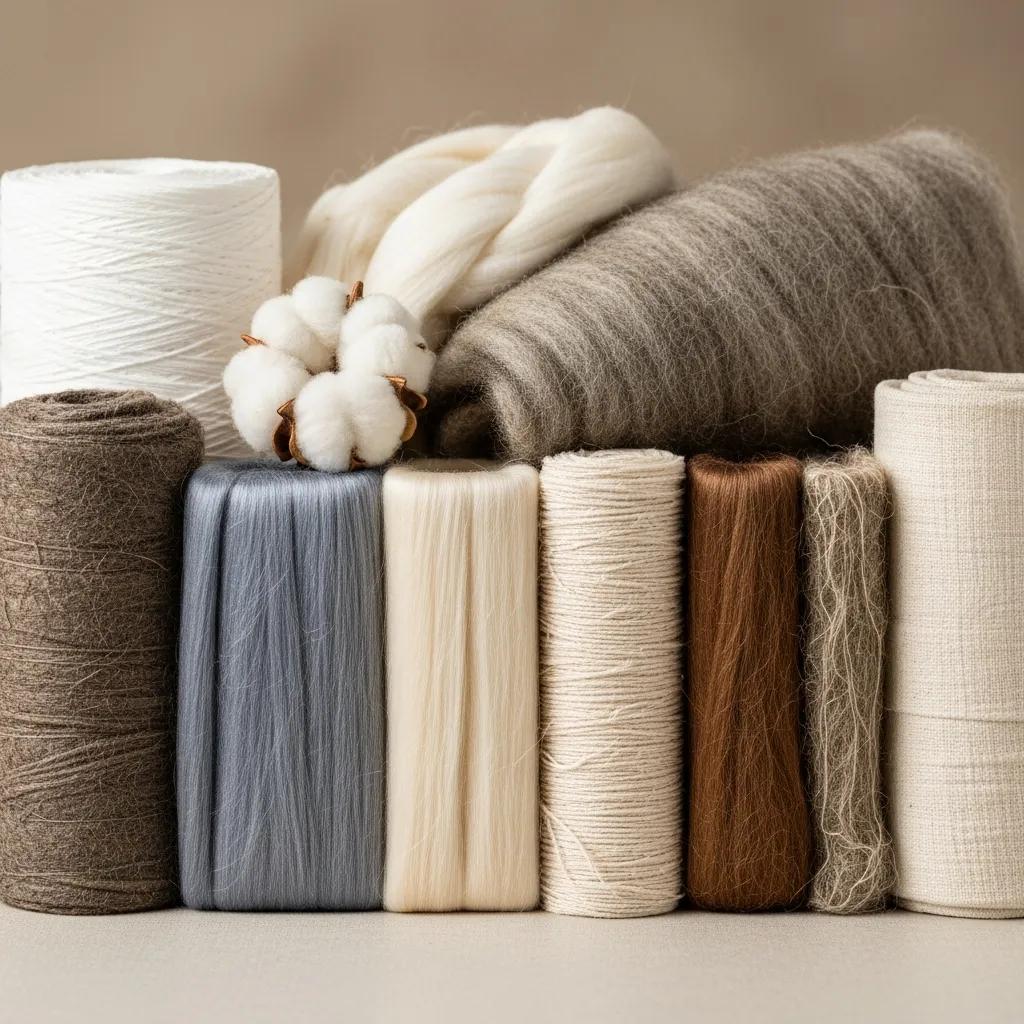
Natural fibers are derived from plants and animals, and their inherent biochemical structure dictates properties like moisture absorption, dye uptake, and thermal behavior, which in turn guide garment decisions. Cotton, a cellulose-based fiber, is highly breathable and comfortable, making it a prime choice for shirts and casualwear where absorbency and softness are key. Designers should opt for pre-shrunk or mercerized cotton to ensure dimensional stability. Wool, with its crimped fibers, effectively traps air for insulation and offers resilience, making it suitable for suiting and outerwear, though considerations for pilling and next-to-skin comfort are important. Silk and linen provide distinct handfeel and drape—silk for fluid eveningwear and linen for structured summer pieces—and both require careful patternmaking and seam allowances to accommodate their behavior during wear and laundering.
Natural fibers originate from plants and animals, and their biochemical structure drives properties such as moisture sorption, dye uptake, and thermal behavior, which in turn inform garment decisions. Cotton, a cellulose fiber, is breathable and comfortable, making it ideal for shirts and casualwear where absorbency and softness are priorities; designers should specify pre-shrunk or mercerized cotton to control dimensional stability. Wool offers crimped fibers that trap air for insulation and resilience; it suits suiting and outerwear but requires consideration of pilling and care when used next-to-skin. Silk and linen deliver distinctive hand and drape — silk for fluid eveningwear and linen for structured summer pieces — and both require tailored pattern and seam allowances to accommodate their behavior in wear and laundering.
Synthetic and blended fabrics — Polyester, Nylon, Rayon, Blends
Synthetic fibers are engineered from polymers to offer consistent performance characteristics like strength, rapid drying, and ease of care. Semi-synthetics, such as rayon, provide a silk-like drape with different moisture-handling capabilities. Polyester and nylon are lauded for their durability and colorfastness, making them go-to materials for activewear and outerwear where abrasion resistance is crucial. Opting for recycled PET (rPET) can help reduce the demand for virgin petrochemical feedstocks. Rayon and viscose offer appealing drape and handfeel but can lose strength when wet, necessitating careful consideration of shrinkage and seam allowances in patterns. Blends, commonly cotton/polyester or wool/nylon, combine comfort with resilience, and selecting specific blend ratios allows for precise tuning of stretch, GSM, and lifecycle performance for targeted applications.
How fabrics are made: from fiber to fabric
Fabric production transforms raw fiber into yarn and then into fabric through spinning and textile constructions. Each stage influences the material’s mechanical and visual properties, ultimately affecting the final garment’s performance. Spinning consolidates fibers into yarns, where yarn count and twist determine strength, drape, and handle. Finer yarns result in smoother surfaces, while higher twist enhances abrasion resistance but can diminish softness. Weaving and knitting are the primary construction methods: weaving yields stable, low-stretch fabrics suitable for structured garments, whereas knitting produces elastic, form-fitting textiles ideal for active and casualwear. Post-construction, dyeing and finishing add color and functional treatments, but these processes also impact sustainability and care, guiding designers toward low-impact methods when lifecycle implications are a priority.
Manufacturers follow a series of key production steps to transform fibers into finished fabrics.
- Spinning: Fibers are carded and drawn into yarn; yarn count and twist establish tensile behavior and surface appearance.
- Weaving/Knitting: Yarn is formed into cloth; the weave type (plain, twill, satin) or knit structure (warp/weft) dictates stretch and drape.
- Dyeing and Finishing: Coloration and functional treatments (e.g., waterproofing, softeners) modify appearance and performance, potentially introducing environmental impacts.
These three core steps form the foundation of fabric manufacturing and naturally lead into discussions about specific construction techniques and sustainable finishing options.
Spinning, weaving, and knitting fundamentals
Spinning transforms staple or filament fibers into yarns, with linear density and twist governing tensile strength and handle. Yarn selection is a critical design decision, influencing stitch definition, drape, and seam performance. Weaving, utilizing plain, twill, or satin drafts, creates interlaced yarns with predictable stability and anisotropic stretch, making woven fabrics ideal for tailored garments requiring structure. Knitting, whether warp or weft, forms looped structures that provide elasticity and recovery, aligning knit choices with body-contouring garments and activewear where stretch and comfort are paramount. Understanding how construction impacts pattern allowances, seam finishes, and interfacing needs is essential for designers to translate a silhouette into a manufacturable specification.
Dyeing, finishing, and sustainable processing
Dyeing and finishing define the final color, handfeel, and functional performance of a fabric, but these processes can be resource-intensive. Traditional dye baths often consume substantial water and chemicals, whereas newer methods aim to reduce waste and energy usage. Finishing treatments like DWR coatings, laminations, and anti-microbial finishes enhance performance such as water resistance and odor control, but they can affect breathability and recyclability, necessitating careful documentation of these trade-offs in specifications. Sustainable alternatives include low-water digital printing, enzyme-based finishes, and dope-dyeing for synthetics, all of which reduce environmental impact and can sometimes improve colorfastness. Designers should approach finish selection with a lifecycle perspective, considering how each finish impacts repairability, washing frequency, and end-of-life recycling to prevent unintended sustainability setbacks.
How material science shapes fashion textiles
Material science bridges polymer chemistry, fiber morphology, and surface engineering to achieve specific garment-level performance. Understanding these connections enables designers to specify fabrics based on measurable outcomes—such as abrasion cycles, MVTR (moisture vapor transmission rate), or GSM—rather than relying solely on subjective assessments. Engineered finishes and coatings modify permeability, UV protection, and liquid repellency by altering surface energy or introducing barriers, though these enhancements can affect care requirements and recyclability. Performance testing, including Martindale abrasion tests for durability or hydrostatic head tests for water resistance, translates material choices into reliable performance expectations for end users and supply chain partners. The table below offers a concise EAV comparison of common material finishes, detailing their functional effects and implications for care and sustainability.
This comparison illustrates how selecting a particular finish influences both the wear experience and lifecycle considerations, highlighting the practical need for collaborative specification workflows.
| Finish / Material | Functional Effect | Mechanism & Design Implication |
|---|---|---|
| Durable Water Repellent (DWR) | Short-term water beading | Lower surface energy; improves repellency but reduces breathability and can require reapplication |
| Lamination / Membrane | Waterproof, windproof | Adds barrier layer (e.g., PU/PTFE); increases protection and reduces stretch/recyclability complexity |
| Anti-microbial finishes | Odor control | Surface-bound agents inhibit microbial growth; may affect skin compatibility and recyclability |
| UV-stabilizers | UV protection | Absorbs or reflects UV; useful for outdoor garments but chemical stability over lifecycle varies |
| Phase-change materials | Thermoregulation | Embed PCM microcapsules for transient heat exchange; enhances wearer comfort in variable climates |
This mapping demonstrates how choosing a finish impacts both the wearer’s experience and lifecycle considerations, underscoring the necessity for collaborative specification processes.
Designers benefit significantly when material performance data is shared and iterated upon within collaborative platforms. For instance, a design team can centralize material libraries, add annotations to lab test results, and create visual and tactile prototypes in shared files to expedite specification decisions. Collaborative design tools streamline the review of material options, enable side-by-side comparisons of finish trade-offs, and facilitate smooth handoffs to technical teams for prototyping and testing. Companies that serve as information hubs and foster team collaboration help minimize iterations between design and supply. Tools supporting shared material libraries and prototype feedback become practical enablers for material-driven design choices.
Key properties that drive garment performance — durability, breathability, moisture management
Durability, breathability, and moisture management are fundamental, measurable properties that dictate how garments perform during use, directly stemming from fiber chemistry, fabric construction, and finishes. Durability is typically assessed through abrasion cycles or tensile tests, informing selections for high-wear items like outerwear and workwear, where high-denier yarns and tighter constructions are advantageous. Breathability, often evaluated via MVTR or air permeability, balances comfort with protective finishes; designers select constructions or membranes based on the required ventilation and weather protection. Moisture management utilizes wicking fibers or engineered hydrophilic/hydrophobic yarn treatments to move perspiration away from the skin, enhancing thermal comfort in activewear and intimate apparel. Specifying target test thresholds helps align laboratory results with actual wearer experience.
Finishes and coatings — impact on performance and care
Finishes and coatings can substantially enhance functionality but introduce complexities regarding care and recyclability. Designers must therefore specify the finish type, its durability, and any reapplication guidance alongside aesthetic requirements. DWR treatments provide water repellency but may degrade with washing and require reapplication, influencing garment maintenance instructions and consumer communication. Laminations and membranes offer waterproofing but complicate repairs and recycling due to their multi-layer nature, impacting end-of-life strategies and repairability standards. Considering the toxicology and environmental implications—such as PFAS concerns—when selecting finishes ensures that functional benefits do not compromise long-term sustainability goals and guides designers toward alternatives aligned with brand commitments.
Sustainable and innovative textiles for fashion
Sustainable textiles aim to minimize environmental impact throughout sourcing, production, and end-of-life stages. Innovative bio-based or recycled materials offer novel aesthetic and performance possibilities, though they require thorough lifecycle evaluation. Materials like rPET and Econyl replace virgin petrochemical feedstocks with reclaimed polyester and regenerated nylon, maintaining comparable performance in many applications while reducing embodied carbon and diverting waste from landfills. Bio-based leather alternatives, such as Piñatex (derived from pineapple fiber) and mycelium-based materials, provide cruelty-free, unique textures but may differ in durability and finishability compared to animal leather, prompting designers to prototype and test for abrasion and flex. The EAV table below assists teams in comparing sustainability metrics and sourcing considerations at a glance.
Organics basis: organic, recycled, and bio-based materials — cotton, rPET, Econyl, Piñatex, Mycelium
Design platforms and shared material libraries can accelerate the selection of sustainable materials by enabling interactive comparisons and collaborative review processes. Teams can tag materials with sustainability scores, attach certification documents, and conduct side-by-side visual mockups to assess aesthetic compatibility. Utilizing collaborative information hubs supports research into trade-offs—such as embodied carbon versus durability—and allows design and sourcing teams to agree on acceptable compromises before prototype development. These platform features facilitate the discussion of lifecycle trade-offs during concept reviews, ensuring sustainable options are considered early in the design process.
Organic, recycled, and bio-based fibers — cotton, rPET, Econyl, Piñatex, Mycelium
Each sustainable fiber presents distinct sourcing and performance trade-offs. Organic cotton reduces chemical inputs but still requires significant water and land resources, while rPET and Econyl lessen the reliance on virgin polymers by recycling plastic and nylon waste into textile feedstocks. Piñatex and mycelium-based materials offer unique aesthetics for leather alternatives but may require surface coatings for abrasion resistance and water exposure, impacting their recyclability. Designers should prototype with these materials early to evaluate their handfeel, stitch behavior, and how finishes interact with the substrate. Supplier transparency regarding feedstock origin and processing steps is crucial for substantiating sustainability claims and accurate specifications.
Smart textiles and circular economy concepts — durability, recyclability, lifecycle
Smart textiles, which incorporate sensors, conductive yarns, or phase-change materials, add functionality but can complicate recyclability. Designers committed to circularity must therefore plan for disassembly and component-level reuse. Circular economy strategies include designing for disassembly, prioritizing mono-material constructions where feasible, and specifying recyclability thresholds that align with available recycling streams. Durability can contribute to circularity by extending a garment’s useful life and reducing the need for frequent replacement. However, longevity must be balanced with the ability to recover materials at end-of-life. Product-level lifecycle assessments are valuable tools for making these trade-offs explicit during design reviews.
Sourcing, ethics, and standards in textile supply
Ethical sourcing involves verifying supplier practices, certifying fibers and processes, and embedding transparency into product specifications to ensure brand claims are verifiable and legally sound. Certifications like GOTS and Oeko‑Tex offer distinct assurances: GOTS focuses on organic fiber production and social criteria, while Oeko‑Tex addresses chemical safety in textiles. Designers should request specific documentation that aligns with their claims. Practical steps for traceability include obtaining mill test reports, conducting supplier audits, and centralizing certification documents in a shared repository to support product compliance and marketing narratives. Adhering to these practices reduces risk and connects material choices to verifiable ethical outcomes, which then informs specification language and consumer-facing claims.
Certifications and standards — GOTS, Oeko-Tex, etc.
Certifications translate complex supply-chain practices into verifiable claims. GOTS certifies organic fiber content and encompasses environmental and social criteria across processing stages, while Oeko‑Tex verifies low chemical content in finished textiles for consumer safety. Designers should request certificate numbers, scope (fiber, fabric, or finished product), and validity dates from suppliers to confirm claims. It’s also important to understand which certification best supports your marketing objectives and regulatory context. Integrating certification requirements into tech packs and sourcing RFPs ensures suppliers are aware of expectations from the outset and supports traceability throughout production and shipment.
Supply chain transparency and ethical production practices
Enhancing transparency requires specific processes—such as supplier audits, chain-of-custody documentation, and centralized storage of certificates—along with tools that enable teams to annotate and share evidence across design, sourcing, and compliance functions. Centralizing supplier files, test results, and certifications within a collaborative system streamlines design-to-supply handoffs and minimizes the risk of misplaced documentation during product development. Collaborative platforms that act as information hubs help teams track traceability notes, manage audit findings, and keep supplier communications linked to specific material items, ensuring ethical sourcing is an integral part of the design workflow rather than an afterthought.
This article has outlined core fabric types, production processes, material science principles, sustainable material options, and best practices for sourcing, collectively forming a practical knowledge base for designers and product teams.
Conclusion
A deep understanding of fabrics and materials empowers designers to make informed decisions that elevate garment performance and sustainability. By harnessing knowledge of fiber properties, production methods, and ethical sourcing, teams can create fashion that is both innovative and responsible. Embrace the transformative potential of textiles to enhance your designs and align with your brand values. Explore our resources and connect with industry experts to further your textile expertise today.