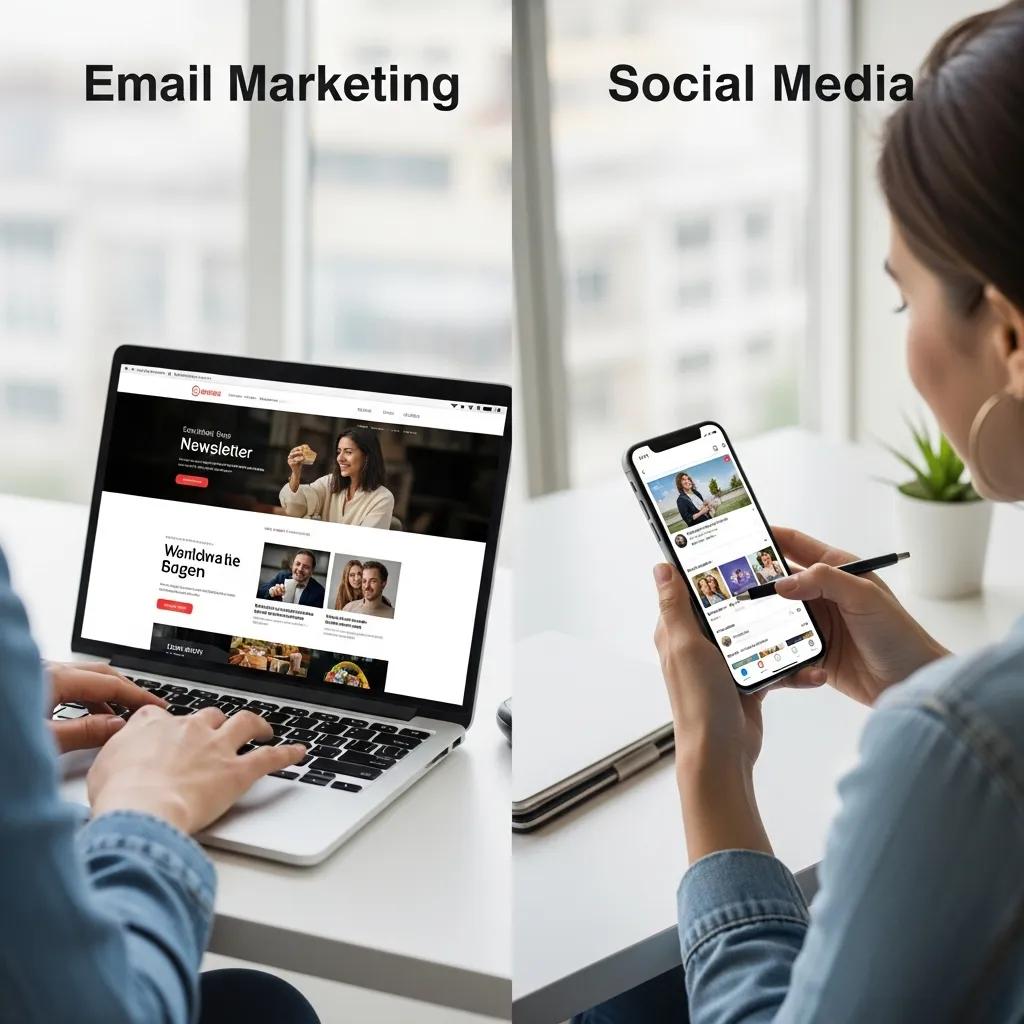
Email Marketing vs Social Media: What Works Better for ROI, Engagement, and Conversion in 2025?
Email marketing and social media are two core pillars of digital marketing with distinct strengths: email delivers owned, permissioned messaging optimized for conversion, while social channels excel at discovery and broad reach. This article shows where each channel outperforms the other on ROI, engagement, and conversion in 2025, and it maps practical ways to combine them into measurable funnels. Many marketers struggle to decide whether to prioritize list growth, paid social spend, or a blended approach; this guide diagnoses the trade-offs and prescribes tactics you can apply today. You will learn what drives email’s higher ROI, how social drives awareness and virality, side-by-side performance metrics for 2025, integration workflows that convert discovery into revenue, and the near-term trends (AI, privacy, behavior) shaping both channels. The article includes comparison tables, actionable lists, and integration playbooks that translate metrics into steps, plus a focused explanation of why Gmail’s reliability, security, and integrations matter practically for deliverability and analytics. Read on to decide which channel to emphasize for specific goals and how to architect a cross-channel machine that captures and converts attention.
What Is Email Marketing and Why Does It Deliver High ROI?
Email marketing is the practice of sending targeted, permissioned messages to a subscriber list to inform, nurture, and convert prospects into customers. It works because email provides direct inbox delivery, high degrees of personalization through segmentation and automation, and ownership of the audience that avoids platform algorithm risk. The result is predictable conversion pathways where behavioral triggers, drip campaigns, and tailored offers repeatedly convert engaged subscribers at higher rates than most rented channels. Understanding these mechanics explains why industry metrics for 2025 still show email delivering markedly higher ROI for many use cases, especially when combined with good list hygiene and analytics-driven optimization.
Email marketing’s strengths arise from three operational levers: segmentation, automation workflows, and measurement. Segmentation increases relevance by matching messages to lifecycle stage, automation applies timely triggers to accelerate conversion, and measurement ties opens and clicks to revenue. These levers create a virtuous loop where engagement improves sender reputation and deliverability, which in turn supports higher inbox placement and stronger ROI. That foundation leads naturally to an exploration of how email creates direct communication and true audience ownership.
How Does Email Marketing Provide Direct Communication and Audience Ownership?
Email provides audience ownership by creating a permissioned, portable channel that belongs to the brand rather than a third-party platform, and that ownership enables repeated, measurable outreach. Subscribers opt in and give explicit consent, which lets marketers use lifecycle campaigns, transactional triggers, and re-engagement sequences without relying on algorithmic feeds. Practically, list hygiene—removing inactive addresses, using double opt-in, and authenticating senders—preserves sender reputation and improves deliverability. Treating the list as an asset means measuring subscriber lifetime value and using CRM integrations to enrich profiles for better personalization and targeting.
This ownership model contrasts with rented audiences on social platforms that can disappear when algorithms or policies change, so maintaining a robust email list is a hedge against platform volatility. Building that list requires steady acquisition tactics, and the next section explains the concrete benefits email offers over social media for conversion and ROI.
What Are the Key Benefits of Email Marketing Over Social Media?

Email consistently delivers higher per-dollar returns because it combines one-to-one relevance with scalable automation, and 2025 benchmarks show meaningful ROI and conversion advantages. Email’s personalization (behavioral triggers, product recommendations) increases click-through and conversion rates, and automation reduces friction by delivering the right message at the right time. Unlike social feeds, email campaigns can be A/B tested across subject lines, send cadence, and creative, producing iterative gains in performance that compound over time. These characteristics make email especially effective for nurture sequences, cart recovery, subscription renewal, and measured reactivation.
Key tactical takeaways include rigorous segmentation, dynamic content to surface personalized offers, and continuous testing of sender, subject, and timing to lift engagement. Maintaining authentication (SPF/DKIM/DMARC) and removing low-engagement recipients keeps delivery high and costs per conversion low. Those operational best practices naturally bridge into how social media builds the top of funnel through discovery and engagement.
How Does Social Media Marketing Build Brand Awareness and Engagement?
Social media marketing uses platform feeds, communities, and paid placements to expose content to large audiences for discovery, brand storytelling, and social proof. It operates through shareable creative, influencer amplification, and algorithmic surfacing to generate impressions and interactions that scale quickly. The primary value is driving awareness and initial interest — social creates demand, initiates viral moments, and amplifies brand identity where email cannot reach without prior consent. When social success occurs, the channel creates low-friction opportunities to capture attention and funnel prospects into owned channels for conversion.
However, social’s effectiveness depends on platform mechanics, creative resonance, and paid amplification to overcome declining organic reach. Marketers should treat social as the discovery layer and pair it with deliberate conversion pathways so awareness translates into measurable outcomes. The following subsection outlines core advantages that make social indispensable for top-of-funnel activity.
What Are the Main Advantages of Social Media Marketing for Discovery and Virality?
Social channels excel at discovery because their feeds and sharing mechanics expose content to audiences beyond a brand’s immediate followers, enabling viral amplification when content triggers shares and engagement. Platform formats — short video, stories, and interactive posts — increase the chance of rapid spread when they include strong hooks and social proof. Metrics to monitor include impressions, share rate, and new follower acquisition, which together indicate discovery velocity and potential downstream conversion. Tactics that increase virality include compelling creative, clear share triggers, and coordinated timing with broader campaigns.
Effective social campaigns use creative experimentation and quick iteration to identify formats that resonate, and they plan for the conversion step by directing traffic to list-building assets. After awareness is achieved on social, the next topic examines how algorithms shape visibility and why paid strategies often complement organic efforts.
How Do Social Media Algorithms Affect Content Visibility and Audience Reach?
Social algorithms curate content based on signals such as engagement, relevance, and timeliness, which concentrates reach on posts that quickly attract interaction and reduces visibility for low-engagement content. This engagement-weighted distribution means brands must either create highly shareable content or invest in paid amplification to reach target audiences consistently. As organic reach declines on many platforms, paid social and community management become essential to maintain predictable reach and reduce reliance on viral luck. Practical responses include using retargeting to capture engaged visitors and establishing consistent content calendars to build steady engagement signals.
Understanding algorithm dynamics highlights why social is a discovery channel and why marketers should structure funnels that capture social traffic into owned pathways, which leads directly into a head-to-head comparison of performance metrics.
How Do Email Marketing and Social Media Compare on Key Performance Metrics?
Email and social diverge materially on ROI, conversion, reach, engagement, and cost-effectiveness, and choosing the right mix depends on whether the objective is awareness, acquisition, or retention. In 2025 benchmarks, email shows substantially higher ROI and conversion rates per dollar invested, while social offers vastly larger potential reach and stronger discovery opportunities. Cost per acquisition and channel economics will vary by industry and creative quality, but the general pattern favors email for conversion efficiency and social for scalable awareness. The table below summarizes those comparative metrics to help prioritize investments based on concrete outcomes.
The table presents side-by-side 2025 metric ranges and interprets the drivers behind them.
| Channel | Performance Metric | 2025 Range |
|---|---|---|
| Email Marketing | ROI (per $1 spent) | $36–$45 |
| Email Marketing | Conversion Rate (site actions) | 4.2%–8% |
| Social Media | ROI (per $1 spent) | $2–$10 |
| Social Media | Conversion Rate (site actions) | 1.9%–3% |
What Are the 2025 ROI and Conversion Rate Differences Between Email and Social Media?
Email outperforms social on ROI and conversion rate due to direct permissioned access, high personalization, and automation that targets users when intent is high. The 2025 ranges—email ROI around $36–$45 per $1 and conversions around 4.2–8%, versus social ROI $2–$10 and conversions around 1.9–3%—capture the structural advantage of owned channels. Drivers include list quality, relevance from segmentation, and triggered messaging that addresses immediate needs; social conversions often require additional steps or paid retargeting to match email efficiency. However, social conversion can be competitive for impulse purchases, social commerce contexts, or when ad creative aligns closely with purchase intent.
Understanding these drivers helps marketers decide when to prioritize list building and when to invest incrementally in paid social to seed volume. The following subsection contrasts reach, engagement patterns, and relative costs to translate metrics into tactical choices.
How Do Reach, Engagement, and Cost-Effectiveness Vary Between Email and Social Media?
Social channels offer far greater potential reach because they surface content to broad audiences and leverage network effects, but actual delivered reach is often limited by algorithms and paid budgets. Email’s delivered reach is narrower but more targeted and intentional, yielding higher engagement per contact and lower marginal cost per conversion when lifecycle automation is in place. Cost-effectiveness therefore depends on the funnel stage: use social for efficient reach and testing, then move qualified prospects into email for conversion. Budget allocation should reflect these roles: allocate funds to paid social for discovery and A/B testing, and invest operating budget in email automation and list hygiene to maximize return on clicks.
This reach versus conversion trade-off highlights personalization as a key multiplier for email; the next subsection explores personalization’s role in improving email engagement.
What Role Does Personalization Play in Improving Email Marketing Engagement?
Personalization—through segmentation, dynamic content, and behavioral triggers—directly increases opens, clicks, and conversions by matching messages to user intent and context. Examples include transactional triggers for abandoned carts, product recommendations via past purchase behavior, and dynamic content that displays region-specific offers. Implementing personalization requires data integration between CRM, marketing automation, and analytics, plus rules for content selection and testing. Expected uplifts depend on execution but typically manifest as double-digit percentage improvements in open and click rates when personalization is consistent and data quality is high.
Effective personalization strategies also require governance: define segments, guardrails for automated content, and continuous measurement to prevent irrelevant messaging that harms engagement. That leads into how social virality affects brand awareness and how to capture viral traffic into owned channels.
How Does Social Media’s Virality Potential Influence Brand Awareness?

Virality creates rapid spikes in awareness that can generate significant traffic and social proof, but viral moments are unpredictable and often short-lived unless converted into owned relationships. A viral post drives impressions and attention, but without mechanisms to capture that audience—such as lead magnets, retargeting pixels, or sign-up calls to action—the uplift dissipates. Marketers should prepare for viral spikes by having landing pages, email capture flows, and retargeting audiences ready to harvest interest. Relying solely on virality for sustained growth is risky, so the smartest strategies use viral reach as an accelerator that feeds the email funnel for durable value.
Preparing conversion touchpoints during viral campaigns ensures awareness becomes measurable revenue, and the next section outlines stepwise integration playbooks for combining social discovery with email nurture.
How Can Email Marketing and Social Media Be Integrated for Maximum Marketing Success?
Integrating social and email creates a predictable funnel: social drives discovery and list growth, email nurtures and converts, and analytics ties the loop together for optimization. A clear integration playbook uses social content and ads to capture leads into segmented lists, then applies automated email sequences to move prospects through the funnel toward purchase or retention. Measurement depends on consistent UTM tagging, CRM audience mapping, and cross-channel attribution to evaluate which social creative and lists deliver the best lifetime value. Executing this integration requires coordination between content, paid, and email teams to align messaging and timing.
Below are practical use cases and tactical steps that exemplify the integration pattern and the metrics to track.
What Are Effective Use Cases for Combining Email and Social Media Campaigns?
Several concrete use cases leverage social to feed email workflows and email to amplify social outcomes, such as product launches, event registrations, and cart recovery sequences. For a product launch, social builds awareness and drives pre-orders while email nurtures interested subscribers with exclusive offers and product education. For events, social attracts registrants and email sequences confirm attendance and deliver reminders. For abandoned carts, social retargeting reinforces email reminders to recapture intent. Key KPIs include list sign-ups, conversion rate from sign-up to purchase, cost per acquisition, and subscriber lifetime value.
These use cases demonstrate that aligning creative and timing across channels improves conversion efficiency, and the next subsection drills into specific tactics for using social features to build email lists and enrich personalization.
How Can Social Media Help Build Email Lists and Enhance Email Campaigns?
Social platforms provide multiple list-building tools—lead generation forms, gated content, contests, and shoppable posts—that reduce friction for sign-ups and feed data into email automation. Passing contextual data from social (source, campaign, ad creative) into email segments allows teams to tailor welcome sequences based on acquisition channel and intent. Practical steps include using lead forms with prefilled fields, offering high-value content in exchange for email addresses, and syncing leads into the CRM for immediate segmentation. This data enrichment enables more targeted triggers and product recommendations in subsequent email flows.
To summarize integration roles and tactical examples, the table below maps channels to best uses and tactical examples to operationalize the social → email → conversion funnel.
| Channel | Best Use Case | Tactical Example |
|---|---|---|
| Social Media | Discovery & list growth | Run lead ads with gated webinar sign-ups |
| Email Marketing | Nurture & convert | Send a 5-email onboarding sequence with offers |
| Paid Social | Scale qualified traffic | Use lookalike audiences to drive sign-ups |
| CRM / Automation | Personalization & triggers | Enrich segments and fire behavioral automations |
What Are the Future Trends Impacting Email and Social Media Marketing in 2025 and Beyond?
The near future of digital marketing is shaped by three major trends: rapid adoption of AI for personalization and creative, increasing privacy and regulation affecting tracking and attribution, and evolving consumer preferences for private, mobile-first experiences. AI enables faster subject line optimization, predictive audience scoring, and automated content generation across email and social, changing how teams craft and scale messages. Privacy shifts require brands to prioritize first-party data collection (owned lists), cookieless measurement strategies, and transparent consent practices. Consumer attention fragmentation means marketers must be selective about channels and optimize for mobile consumption and concise creative formats.
These trends suggest a strategic shift: invest in owned audiences and data infrastructure, embrace AI-assisted creativity with human oversight, and design cross-channel experiments that do not rely solely on third-party identifiers. The following subsections detail AI’s role and behavior changes that marketers must address.
How Will AI Transform Personalization and Automation in Email and Social Media?
AI will automate much of the segmentation, subject line testing, and creative variation processes, enabling hyper-personalized messaging at scale through predictive content selection and timing optimization. Practical AI use cases include subject-line and preheader optimization for email, predictive scoring to prioritize high-value leads, and automated ad creative variants for social testing. Marketers should adopt guardrails for AI—reviewing outputs, maintaining brand voice, and continuously validating models against performance metrics. Data hygiene and integration remain prerequisites: AI amplifies results only when fed high-quality behavioral and CRM data.
The integration of AI into email marketing automation, as demonstrated by systems that leverage large language models for subject generation and stable diffusion for content images, has shown significant improvements in engagement metrics.
AI-Driven Email Marketing Automation for Enhanced Engagement and Conversion
The system uses finetuned large language models for compelling email subject generation and finetuned stable diffusion model for visually appealing and convincing email content images creation. For the latter, both knowledge graphs and vector embeddings have been incorporated to improve contextual relevance. Experimental results demonstrated significant improvement in all engagement metrics that marketers rely on, including 46% growth in open rates, 56% higher click-through rates, and an 51% boost in conversion rates, all compared to human generated content. The unified approach presented by this paper outperforms standalone models and human-generated content in terms of engagement, as the co
Artificial intelligence-driven integrated system for comprehensive email marketing automation, S Loukili, 2025
Adopting AI responsibly means setting monitoring thresholds, defining KPIs for automated experiments, and keeping humans in the loop for strategy and creative judgment. With these controls, AI multiplies personalization efforts across both channels, and the next subsection explains how consumer behaviors and channel preferences are evolving.
How Are Consumer Behaviors and Channel Preferences Evolving in Digital Marketing?
Consumers increasingly favor private, intent-driven channels and expect quick, mobile-optimized experiences; this shifts attention away from passive feed browsing toward direct, contextual interactions. Email remains a trusted channel for transactional communication and personalized offers, while social behavior fragments across short-form video, ephemeral content, and private messaging groups. Marketers must adapt by creating mobile-first creatives, prioritizing fast sign-up flows, and building value propositions that justify exchange of contact data. Tracking preferences and testing channel mixes will reveal the optimal balance between reach and conversion for each audience segment.
The research into AI-powered personalization in email marketing, utilizing NLP and collaborative filtering, highlights how tailored content can significantly enhance customer engagement and conversion rates.
AI-Powered Personalization in Email Marketing: NLP and Collaborative Filtering for Engagement
This research paper investigates the impact of artificial intelligence (AI)-driven personalization on the efficacy of email marketing, focusing on the integration of natural language processing (NLP) and collaborative filtering algorithms. As digital marketing evolves, the ability to deliver tailored content to individual users has become paramount. This study explores how AI technologies can be harnessed to enhance customer engagement and conversion rates in email campaigns. Using a dataset comprising diverse email marketing campaigns and user interaction histories, we developed an AI framework that combines NLP for content analysis and generation with collaborative filtering for personalized recommendations. Our model leverages NLP to analyze and categorize user preferences and behavioral data, facilitating the generation of personalized email content that aligns with recipient interests and past interactions. Simultaneously, collaborative filtering algorithms identify patter
Enhancing email marketing efficacy through ai-driven personalization: Leveraging natural language processing and collaborative filtering algorithms, A Sharma, 2020
Practically, this means investing in first-party data capture and optimizing welcome journeys to convert mobile social traffic into long-term subscribers. With this context, it becomes important to understand how infrastructure choices affect deliverability—specifically why Gmail matters for email outcomes.
Why Is Gmail’s Reliability and Security Crucial for Successful Email Marketing?
Gmail’s widespread use and its delivery and security systems materially affect marketers because inbox placement, spam filtering, and sender trust determine whether messages reach subscribers and generate engagement. Gmail provides reliable delivery mechanisms and advanced spam protection that influence campaign performance, and integration opportunities with analytics and productivity tools help teams measure and iterate. For marketers, relying on providers with strong deliverability signals and security features reduces the risk of messages being filtered and improves the likelihood that personalization and automation produce revenue. Below we outline how Gmail supports deliverability and the kinds of integrations that streamline marketing workflows.
Understanding these infrastructure benefits clarifies why choosing and configuring mailbox signals—authentication, engagement strategies, and sending practices—is essential for converting email activity into measurable ROI.
How Does Gmail Support High Deliverability and Protect Against Spam?
Gmail uses sender authentication, engagement signals, and sophisticated spam filtering to decide which messages land in the inbox, and marketers must align with these mechanisms through best practices. Authentication standards such as SPF, DKIM, and DMARC are foundational to proving sender identity and improving reputation, and maintaining recipient engagement through relevant content and list hygiene signals positive behavior to inbox providers. Gmail’s spam-protection mechanisms evaluate content, sender history, and recipient interaction to mitigate unsolicited mail, which encourages marketers to avoid spammy language and to manage bounce and complaint rates diligently. By following these practices, marketers increase deliverability and preserve the long-term value of their email programs.
Good deliverability practices therefore include proactive list cleaning, engagement-based segmentation, and careful monitoring of complaints and bounces, which in turn lead to more reliable campaign outcomes and stronger ROI. The final subsection describes integration opportunities with productivity and analytics tools that amplify these operational benefits.
What Integration Opportunities Does Gmail Offer for Marketers Using Google Workspace?
Gmail’s integration potential with Google Workspace and analytics tools enables marketers to streamline workflows, share assets, and connect engagement signals to measurement systems for clearer attribution. Integration examples include using collaborative documents and drive assets to centralize creative, calendar invites for event promotion coordination, and passing campaign engagement data into analytics pipelines for cross-channel reporting. These integrations help teams reduce friction between content production and measurement, making it easier to tie email sequences to social campaigns and to evaluate which acquisition sources drive the most valuable subscribers. Leveraging these integration points supports faster iterations and tighter alignment between discovery and conversion efforts.
By treating Gmail and workspace integrations as part of the marketing stack, teams can improve campaign operations, sustain deliverability, and create a feedback loop that turns audience engagement into reliable revenue signals.
The overarching strategy of integrating multi-channel marketing, encompassing email and social media, is crucial for maximizing digital conversion and ROI, as supported by extensive research.
Multi-Channel Marketing Strategies for Maximizing Digital Conversion and ROI
In an increasingly digitized and data-saturated marketplace, the integration of multi-channel marketing strategies has become essential for organizations aiming to enhance customer engagement, streamline user experiences, and improve return on investment (ROI). This systematic review examines the evolution and effectiveness of integrated digital marketing approaches by synthesizing findings from 85 peer-reviewed studies published between 2005 and 2022. It investigates how the convergence of strategic channel coordination, artificial intelligence (AI)-driven personalization, CRM and CDP infrastructure, behavioral retargeting mechanisms, and ethical data governance collectively influence digital marketing performance across industries and platforms. The review reveals that channel orchestration—defined as the coordinated deployment of marketing messages across platforms such as email, mobile applications, websites, social media, and offline touchpoints—consistently leads to impro
MARKETING CAPSTONE INSIGHTS: LEVERAGING MULTI-CHANNEL STRATEGIES FOR MAXIMUM DIGITAL CONVERSION AND ROI, AJ Mou, 2024