Category: Category1

  • Best Practices for API Design and Documentation

    Best Practices for API Design and Documentation

    Developer working on API design in a modern workspace, surrounded by digital elements

    Best Practices for API Design and Documentation: Comprehensive Guide for Developers and Businesses

    Effective API design and documentation are crucial for ensuring seamless integration and usability for developers and businesses alike. This comprehensive guide will explore the best practices that can enhance API design and documentation, making them more user-friendly and efficient. By understanding the core principles of effective API design, developers can create APIs that are not only functional but also intuitive for users. Many organizations struggle with poorly designed APIs that lead to confusion and inefficiencies. This guide aims to provide solutions through best practices, REST API design guidelines, documentation standards, security measures, and ways to enhance developer experience. We will cover the core principles of effective API design, implementation of REST API guidelines, standards for high-quality documentation, security best practices, and strategies to improve developer experience.

    What Are the Core Principles of Effective API Design?

    Effective API design is grounded in several core principles that ensure usability and functionality. These principles include resource-oriented design, consistency, predictability, and user-centric approaches. By adhering to these principles, developers can create APIs that are easier to understand and integrate.

    How Does Resource-Oriented Design Enhance API Usability?

    Developer analyzing resource-oriented design concepts on a digital screen

    Resource-oriented design focuses on the representation of resources and their interactions. This approach enhances usability by providing a clear structure that developers can easily navigate. For instance, using RESTful principles, APIs can expose resources through well-defined endpoints, making it intuitive for developers to access and manipulate data. This clarity reduces the learning curve and fosters a better developer experience.

    Why Are Consistency and Predictability Vital in API Design?

    Consistency and predictability are essential for creating a reliable API. When APIs follow consistent naming conventions and response formats, developers can anticipate how to interact with the API without extensive documentation. For example, if an API consistently uses plural nouns for collections and singular nouns for individual resources, developers can quickly understand the structure. This predictability not only improves usability but also reduces errors during integration.

    How to Implement REST API Design Guidelines for Scalable Services?

    Implementing REST API design guidelines is crucial for building scalable and maintainable services. These guidelines encompass best practices for HTTP methods, status codes, resource naming, and payload structures. By following these practices, developers can ensure their APIs are robust and easy to use.

    What Are Best Practices for HTTP Methods and Status Codes?

    Using the correct HTTP methods and status codes is fundamental to RESTful API design. The primary methods include GET, POST, PUT, DELETE, and PATCH, each serving a specific purpose. For instance, GET is used to retrieve data, while POST is for creating new resources. Additionally, using appropriate status codes, such as 200 for success, 201 for resource creation, 204 for successful requests with no content, and 404 for not found, provides clear feedback to developers about the outcome of their requests. This clarity helps in debugging and enhances the overall user experience.

    How Should Resource Naming and Payload Structures Be Defined?

    Defining clear resource naming conventions and payload structures is vital for API usability. Resource names should be descriptive and follow a consistent pattern, such as using nouns for resources and avoiding verbs in endpoint paths. For example, an endpoint for retrieving user data could be named , while creating a new user would use the POST method on the same endpoint. Furthermore, payload structures should be standardized, using JSON as the preferred format, to ensure that data is easily consumable by clients.

    What Standards Ensure High-Quality API Documentation?

    High-quality API documentation is essential for facilitating developer understanding and usage. Standards for documentation include audience-centric writing, adherence to the OpenAPI Specification, and regular updates to keep content relevant. By following these standards, organizations can create documentation that effectively supports developers.

    How to Write Developer-Centric API Documentation?

    Writing developer-centric API documentation involves understanding the target audience and their needs. Documentation should be clear, concise, and structured logically. Including code examples, use cases, and detailed explanations of endpoints can significantly enhance the usability of the documentation. Additionally, providing a quick start guide can help developers get up and running quickly, reducing frustration and improving adoption rates.

    What Role Does the OpenAPI Specification Play in Documentation?

    The OpenAPI Specification (OAS) plays a crucial role in standardizing API documentation. By defining a clear structure for API endpoints, parameters, and responses, OAS enables automatic generation of documentation and client libraries. This standardization not only saves time but also ensures that documentation is always in sync with the API itself. Utilizing OAS can lead to more accurate and comprehensive documentation, ultimately benefiting developers.

    Further advancements in this area explore how unstructured HTML documentation can be transformed into standardized OpenAPI specifications, leveraging modern AI techniques.

    Generating Standardized OpenAPI Specifications from HTML Documentation

    ABSTRACT: AbstractAI agents and business automation tools interacting with external web services require standardized, machine-readable information about their APIs in the form of API specifications. However, the information about APIs available online is often presented as unstructured, free-form HTML documentation, requiring external users to spend significant time manually converting it into a structured format. To address this, we introduce , a novel framework that transforms long and diverse API documentation pages into consistent, machine-readable API specifications.


    Generating OpenAPI Specifications from Online API Documentation with Large Language Models, K Lazar, 2025

    Which API Security Best Practices Protect Your Services and Users?

    Developer monitoring API security protocols in a high-tech server room

    API security is paramount in protecting both services and users from potential threats. Implementing best practices for authentication, authorization, rate limiting, and input validation can significantly enhance API security. By prioritizing these practices, developers can safeguard their APIs against common vulnerabilities.

    How to Implement Authentication and Authorization Effectively?

    Effective authentication and authorization are critical for securing APIs. Utilizing OAuth 2.0 is a widely accepted method for managing access tokens and ensuring that only authorized users can access specific resources. Additionally, implementing multi-factor authentication can further enhance security by requiring users to provide multiple forms of verification. This layered approach helps protect sensitive data and maintain user trust.

    What Are Strategies for Rate Limiting and Threat Mitigation?

    Rate limiting is an essential strategy for preventing abuse and ensuring fair usage of API resources. By setting limits on the number of requests a user can make within a specific timeframe, developers can mitigate the risk of denial-of-service attacks. Additionally, implementing threat detection mechanisms, such as monitoring for unusual patterns of behavior, can help identify and respond to potential security threats proactively.

    How Can Developer Experience Be Enhanced Through API Design and Documentation?

    Enhancing developer experience is crucial for fostering adoption and satisfaction with APIs. By focusing on onboarding tools, testing tools, and feedback integration, organizations can create a more supportive environment for developers.

    What Onboarding and Testing Tools Improve Developer Adoption?

    Onboarding tools, such as interactive API explorers and sandbox environments, allow developers to experiment with APIs in a safe setting. These tools can significantly reduce the learning curve and encourage experimentation. Additionally, providing comprehensive testing tools, such as automated testing frameworks, can help developers ensure their integrations work as intended, further enhancing their experience.

    How Does Feedback Integration Foster Continuous API Improvement?

    Integrating feedback mechanisms into the API lifecycle is vital for continuous improvement. By actively soliciting feedback from developers, organizations can identify pain points and areas for enhancement. Implementing a feedback loop allows for iterative improvements, ensuring that the API evolves to meet the changing needs of its users. This responsiveness not only improves the API but also fosters a sense of community and collaboration among developers.

    API Design PrincipleDescriptionBenefit
    Resource-Oriented DesignFocuses on resources and their interactionsEnhances usability and clarity
    ConsistencyFollows uniform naming and response formatsReduces learning curve and errors
    PredictabilityAnticipates developer interactionsImproves integration experience

    This table summarizes the core principles of effective API design, highlighting their importance in creating user-friendly APIs.

    HTTP MethodPurposeCommon Status Codes
    GETRetrieve data200 (OK), 404 (Not Found)
    POSTCreate new resources201 (Created), 400 (Bad Request)
    PUTUpdate existing resources200 (OK), 204 (No Content)
    DELETERemove resources204 (No Content), 404 (Not Found)

    This table outlines the best practices for HTTP methods and status codes, emphasizing their roles in RESTful API design.

    Documentation StandardKey FeatureBenefit
    Audience-Centric WritingTailored content for developersEnhances understanding and usability
    OpenAPI SpecificationStandardized API structureFacilitates automatic documentation generation
    Regular UpdatesKeeps content relevantEnsures accuracy and usability

    This table compares different standards for high-quality API documentation, illustrating their benefits for developers.

    Frequently Asked Questions

    What are the common challenges faced in API design?

    Common challenges in API design include ensuring usability, maintaining consistency, and managing versioning. Developers often struggle with creating intuitive endpoints that are easy to navigate. Additionally, inconsistencies in naming conventions and response formats can lead to confusion. Versioning is another critical issue, as changes to an API can disrupt existing integrations. Addressing these challenges requires careful planning and adherence to best practices, ensuring that the API remains user-friendly and adaptable over time.

    How can I test my API effectively?

    Effective API testing involves several strategies, including unit testing, integration testing, and performance testing. Unit tests focus on individual components, ensuring they function correctly in isolation. Integration tests verify that different parts of the API work together seamlessly. Performance testing assesses how the API behaves under various loads, identifying potential bottlenecks. Utilizing automated testing tools can streamline this process, allowing for continuous testing throughout the development lifecycle, which ultimately enhances reliability and user satisfaction.

    What tools can assist in API documentation?

    Several tools can assist in creating and maintaining API documentation, including Swagger, Postman, and ReadMe. Swagger allows developers to design, build, and document APIs using the OpenAPI Specification, facilitating automatic documentation generation. Postman provides a user-friendly interface for testing APIs and generating documentation based on requests. ReadMe offers customizable documentation solutions that can be easily updated and shared. These tools help ensure that documentation remains accurate, accessible, and user-friendly, enhancing the overall developer experience.

    How can I ensure my API is secure?

    To ensure API security, implement best practices such as using HTTPS, validating inputs, and employing robust authentication methods like OAuth 2.0. Regularly updating your API to patch vulnerabilities is crucial. Additionally, consider implementing rate limiting to prevent abuse and monitoring for unusual activity to detect potential threats. Conducting security audits and penetration testing can also help identify weaknesses. By prioritizing these measures, you can significantly reduce the risk of security breaches and protect user data.

    What is the importance of versioning in API design?

    Versioning is essential in API design as it allows developers to introduce new features and improvements without disrupting existing users. By maintaining multiple versions, you can ensure backward compatibility, enabling clients to continue using older versions while transitioning to newer ones. This practice helps manage changes effectively, reducing the risk of breaking existing integrations. Clear versioning strategies, such as including version numbers in the URL, can enhance user experience and provide clarity on the API’s evolution over time.

    How can feedback from developers improve API design?

    Feedback from developers is invaluable for improving API design. By actively soliciting input through surveys, forums, or direct communication, organizations can identify pain points and areas for enhancement. This feedback loop allows for iterative improvements, ensuring that the API evolves to meet user needs. Incorporating developer suggestions can lead to more intuitive designs, better documentation, and enhanced overall usability. Fostering a community around the API encourages collaboration and can significantly boost developer satisfaction and adoption rates.

    Conclusion

    Implementing best practices in API design and documentation significantly enhances usability, security, and developer experience. By adhering to core principles and standards, organizations can create APIs that are intuitive and efficient, ultimately driving adoption and satisfaction. To further explore how these practices can transform your API strategy, consider reviewing our additional resources. Start optimizing your API design today for a more seamless integration experience.


  • How SEO-Friendly Content Helps IT Companies Grow Online

    How SEO-Friendly Content Helps IT Companies Grow Online

    Elevate IT Growth with SEO Content

    Elevate IT Growth with SEO Content

    In the digital landscape, SEO-friendly content is crucial for IT companies aiming to enhance their online presence and drive growth. This article explores how effective content marketing strategies can significantly impact organic traffic, lead generation, and overall visibility. By understanding the mechanisms behind SEO-friendly content, IT companies can leverage these strategies to address common challenges such as low website traffic and poor conversion rates. We will delve into the key benefits of SEO-friendly content, explore effective content marketing strategies, and discuss the importance of technical SEO. Additionally, we will examine how to measure SEO ROI and the role of local SEO in enhancing online presence.

    What Are the Key Benefits of SEO-Friendly Content for IT Companies?

    SEO-friendly content offers several advantages that are particularly beneficial for IT companies. By optimizing content for search engines, businesses can increase their organic visibility, enhance credibility, and generate qualified leads. These benefits are essential for establishing a strong online presence in a competitive market.

    How Does SEO Content Increase Organic Traffic and Website Visibility?

    SEO content increases organic traffic by utilizing keyword optimization, which helps search engines understand the relevance of the content. High-quality content that incorporates relevant keywords and phrases attracts more visitors, improving website visibility. Additionally, backlinks from reputable sources further enhance this visibility, as they signal to search engines that the content is trustworthy and valuable.

    In What Ways Does SEO Content Enhance Lead Generation and Conversion Rates?

    SEO content enhances lead generation by targeting the right audience through strategic keyword usage and compelling calls to action. By creating content that addresses the specific needs and pain points of potential customers, IT companies can nurture leads effectively. Case studies and data-driven insights can further support claims, demonstrating the value of the services offered and encouraging conversions.

    Which Content Marketing Strategies Best Support IT Company Growth Online?

    IT team brainstorming content marketing strategies in a collaborative setting

    To maximize online growth, IT companies should adopt effective content marketing strategies that resonate with their target audience. These strategies include creating diverse content types, maintaining a content calendar, and leveraging social media for distribution.

    What Types of SEO-Friendly Content Are Most Effective for Tech Businesses?

    Effective SEO-friendly content types for tech businesses include blogs, whitepapers, and videos. Each format serves a unique purpose: blogs can provide timely insights, whitepapers can offer in-depth analysis, and videos can engage audiences visually. By diversifying content formats, IT companies can cater to different audience preferences and improve engagement metrics.

    How Can IT Companies Develop a Content Calendar to Maximize SEO Impact?

    Developing a content calendar is essential for maintaining a consistent publishing schedule. IT companies should align their content with business goals, ensuring that topics are relevant and timely. Tracking performance over time allows for adjustments based on audience engagement and SEO effectiveness, optimizing the overall impact of the content strategy.

    How Does Technical SEO Complement SEO-Friendly Content for IT Companies?

    Technical SEO plays a vital role in supporting SEO-friendly content by ensuring that websites are optimized for search engines. Key elements such as site speed, mobile-friendliness, and crawlability directly influence user experience and search rankings.

    What Technical SEO Elements Improve Crawlability and User Experience?

    Close-up of a computer screen showcasing technical SEO elements for improved user experience

    Technical SEO elements that enhance crawlability include structured data implementation, XML sitemaps, and proper robots.txt configuration. These components help search engines index content more effectively, improving visibility and user experience. A well-structured website allows users to navigate easily, leading to longer visit durations and lower bounce rates.

    Why Is Mobile-Friendliness and Site Speed Crucial for IT SEO Success?

    Mobile-friendliness and site speed are critical factors for SEO success, as user behavior trends indicate that a significant portion of web traffic comes from mobile devices. Slow-loading pages can lead to high bounce rates, negatively impacting search rankings. Ensuring that websites are optimized for mobile use and load quickly can significantly enhance user experience and retention.

    How Can IT Companies Measure and Optimize SEO ROI and Online Growth?

    Measuring SEO ROI is essential for understanding the effectiveness of content strategies. By identifying key performance indicators (KPIs), IT companies can track their progress and make informed decisions to optimize their strategies.

    Which KPIs Best Reflect SEO Performance for IT Businesses?

    Key performance indicators that reflect SEO performance for IT businesses include organic traffic metrics, conversion rates, and engagement metrics such as average session duration and bounce rate. Monitoring these KPIs allows companies to assess the effectiveness of their content and make necessary adjustments to improve results.

    What Tools Help Track Organic Traffic, Rankings, and Lead Generation?

    Several tools can assist IT companies in tracking SEO metrics, including Google Analytics, SEMrush, and Ahrefs. Google Analytics provides insights into user behavior and traffic sources, while SEMrush and Ahrefs offer comprehensive tools for tracking keyword rankings and backlink profiles. Utilizing these tools can help companies refine their SEO strategies and enhance lead generation efforts.

    What Role Does Local SEO Play in Growing IT Companies’ Online Presence?

    Local SEO is crucial for IT companies looking to enhance their online presence within specific geographic areas. By optimizing for local search, businesses can attract targeted leads and improve visibility in local search results.

    How Can IT Support Services Leverage Local SEO for Targeted Lead Generation?

    IT support services can leverage local SEO by targeting local keywords and building local citations. Engaging with local communities through events and partnerships can also enhance visibility and credibility. By focusing on local SEO strategies, IT companies can effectively reach potential customers in their area.

    What Are Best Practices for Optimizing Google Business Profiles for IT Firms?

    Optimizing Google Business Profiles involves completing all profile information, encouraging customer reviews, and using posts to engage customers. A well-optimized profile can significantly improve local search visibility, making it easier for potential clients to find and connect with IT services.

    How Do IT Companies Build Authority and Trust Through SEO-Friendly Content?

    Building authority and trust is essential for IT companies, and SEO-friendly content plays a significant role in this process. By demonstrating expertise and providing valuable insights, companies can establish themselves as thought leaders in their industry.

    What Is E-E-A-T and Why Is It Important for Tech Content?

    E-E-A-T, which stands for Experience, Expertise, Authoritativeness, and Trustworthiness, is a critical framework for evaluating content quality. For tech content, demonstrating E-E-A-T can enhance credibility and improve search rankings. Companies that showcase their expertise through well-researched content are more likely to gain the trust of their audience.

    How Can Case Studies and Expert Insights Enhance SEO Credibility?

    Incorporating case studies and expert insights into content can significantly enhance SEO credibility. By showcasing real-world results and engaging storytelling, IT companies can illustrate the effectiveness of their solutions. Leveraging expert opinions can further validate claims, building trust with potential clients and improving overall content quality.

    Frequently Asked Questions

    What are the common challenges IT companies face with SEO content?

    IT companies often encounter challenges such as low website traffic, poor conversion rates, and difficulty in reaching their target audience. These issues can stem from a lack of understanding of SEO best practices, ineffective keyword strategies, or insufficient content quality. Additionally, competition in the tech industry can make it harder to stand out. Addressing these challenges requires a comprehensive approach that includes optimizing content, improving technical SEO, and regularly analyzing performance metrics to adapt strategies accordingly.

    How often should IT companies update their SEO content?

    IT companies should aim to update their SEO content regularly, ideally every 3 to 6 months, to ensure it remains relevant and optimized for search engines. This frequency allows businesses to incorporate new keywords, address changing industry trends, and refresh outdated information. Additionally, updating content can improve search rankings and user engagement. Companies should also monitor performance metrics to identify which pieces of content require updates based on traffic and engagement levels.

    What role does user experience play in SEO for IT companies?

    User experience (UX) is crucial for SEO as it directly impacts how visitors interact with a website. Factors such as site speed, mobile-friendliness, and intuitive navigation can influence bounce rates and session durations, which are important ranking signals for search engines. A positive UX encourages users to stay longer and engage with content, leading to higher conversion rates. IT companies should prioritize UX design alongside SEO strategies to enhance overall performance and visibility in search results.

    How can IT companies effectively use social media to boost their SEO efforts?

    IT companies can leverage social media to enhance their SEO efforts by sharing high-quality content that drives traffic back to their websites. Engaging with followers through informative posts, discussions, and industry news can increase brand visibility and encourage shares, which can lead to valuable backlinks. Additionally, social media platforms can serve as a channel for promoting blog posts, case studies, and other content types, helping to reach a broader audience and improve overall search engine rankings.

    What is the significance of keyword research in SEO content strategy?

    Keyword research is fundamental to an effective SEO content strategy as it helps identify the terms and phrases potential customers are using to search for services. By understanding these keywords, IT companies can create targeted content that addresses user intent, improving the chances of ranking higher in search results. Effective keyword research also uncovers long-tail keywords that may have less competition, allowing companies to capture niche audiences and drive qualified traffic to their websites.

    How can IT companies measure the success of their SEO content?

    IT companies can measure the success of their SEO content through various key performance indicators (KPIs) such as organic traffic, conversion rates, and engagement metrics like bounce rate and average session duration. Tools like Google Analytics can provide insights into user behavior and traffic sources, while ranking tools can track keyword performance. Regularly analyzing these metrics allows companies to assess the effectiveness of their content strategies and make data-driven adjustments to improve results.

  • How to Optimize Website Loading Speed: A Complete Performance Guide

    How to Optimize Website Loading Speed: A Complete Performance Guide

    Fast-loading website on a laptop in a modern workspace, symbolizing website performance optimization

    How to Optimize Website Loading Speed: A Complete Performance Guide for Improving Website Performance and Core Web Vitals

    Fast-loading website on a laptop in a modern workspace, symbolizing website performance optimization

    Website loading speed measures how quickly a page becomes usable and visually complete for visitors, and it directly affects user experience, search performance, and conversion rates. This guide explains practical techniques for improving website loading speed, ties each recommendation to Core Web Vitals, and maps audits and monitoring approaches so you can prioritize work effectively. Readers will learn what Core Web Vitals measure, how images and media influence load time, concrete front-end optimizations for CSS and JavaScript, server-side strategies like CDNs and caching, and the tools to audit and continuously monitor performance. The article also highlights how diagnostic tools from Google LLC fit into an ongoing performance workflow without prescribing any vendor lock-in. Start by understanding the key metrics that define perceived and measured speed, then move through asset-level, code-level, and infrastructure-level optimizations so you can reduce LCP, minimize input latency, and shrink layout shifts.

    Further emphasizing the comprehensive nature of performance, research underscores the critical role of front-end optimization in enhancing user experience and achieving business objectives.

    Front-End Optimization for User Experience & Core Web Vitals

    AbstractFront-end performance optimization represents a critical business imperative for organizations developing next-generation digital services in an environment where user expectations continue to rise. This technical article explores how performance optimization directly impacts user satisfaction, conversion rates, and revenue across digital platforms. It explores the evolution of performance measurement through Core Web Vitals, evaluates advanced code splitting strategies, and discusses emerging technologies like WebAssembly for near-native browser performance. The article also covers edge computing implementations, comprehensive image and asset optimization techniques, strategic caching mechanisms, and modern rendering approaches including Server-Side Rendering, Static Site Generation, and Incremental Static Regeneration. These optimization strategies not only enhance technical performance metrics but demonstrably improve business outcomes through increased user engagemen

    Front-End Performance Optimization for Next-Generation Digital Services, 2025

    What Are Core Web Vitals and How Do They Impact Website Speed?

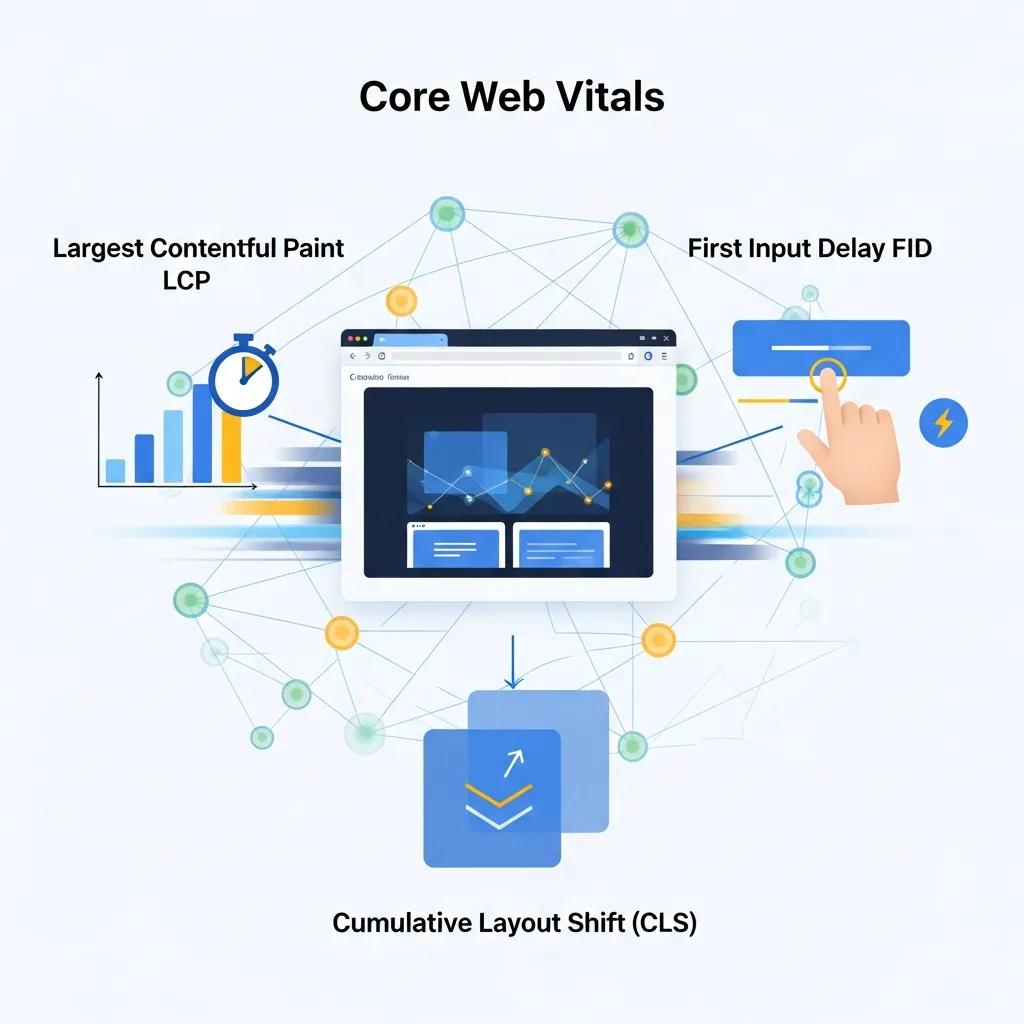
    Visual representation of Core Web Vitals metrics: loading, interactivity, and visual stability

    Core Web Vitals are a focused set of user-centered metrics that quantify loading, interactivity, and visual stability to reflect real-world user experience. They work by measuring specific events during page load—Largest Contentful Paint captures main content load, First Input Delay measures initial interactivity, and Cumulative Layout Shift tracks unexpected visual movement—so each metric maps directly to perceived performance. Improving these metrics typically increases engagement, reduces bounce, and positively influences search performance signals because search systems use field data to evaluate experience. Measuring Core Web Vitals requires both lab tools and real-user field data to find reproducible root causes, and remediations often involve image delivery, main-thread work reduction, and reserving layout space. Understanding these relationships sets up targeted fixes for LCP, FID (and INP as an evolution), and CLS that directly shorten perceived load times and stabilize the viewport for users.

    Core Web Vitals thresholds to target:

    1. LCP: aiming for 2.5 seconds or less for a good experience.
    2. FID: aiming for less than 100 milliseconds (note INP is emerging as a more comprehensive interactivity metric).
    3. CLS: aiming for a score below 0.1 to minimize visual shifts.

    These thresholds provide a clear prioritization: reduce the largest content element’s render time first, then minimize main-thread blocking, and finally stabilize layout behavior to prevent CLS. The next sections explain concrete actions that map to these metrics and show how audits reveal the highest-impact opportunities.

    What Is Largest Contentful Paint and How to Improve It?

    Largest Contentful Paint (LCP) measures when the largest visible element of the viewport finishes rendering, and it matters because users perceive pages as loaded when this element appears. LCP is commonly delayed by large hero images, render-blocking CSS, slow server response times, or heavy client-side rendering workflows, and addressing any of these reduces the time until the page feels usable. To improve LCP, optimize hero images (compress and use next-gen formats), preload critical assets like fonts and hero imagery, reduce CSS blocking by inlining critical CSS, and improve server-side response times through caching and faster hosting. Measuring before-and-after with lab tools and field metrics ensures each change actually reduces LCP rather than only improving synthetic scores.

    Improving LCP often requires coordinated fixes across media, CSS delivery, and server configuration, so start with the single largest candidate element identified in audits and work outward. Once LCP is improved, focus shifts naturally to interactivity and layout stability because faster loading exposes any remaining main-thread or layout problems.

    How to Reduce First Input Delay for Better User Experience

    First Input Delay (FID) quantifies the time between a user’s first interaction and the browser’s ability to respond, and reducing it makes sites feel snappier and more responsive. FID (and INP as a broader replacement) is typically caused by long tasks on the main thread, heavy JavaScript parsing and execution, or large synchronous initializations that block event handling. Practical mitigations include breaking up long tasks into smaller chunks, deferring non-critical JavaScript, using code-splitting and lazy-loading for less-used features, and offloading work to web workers where possible. Tooling such as Chrome DevTools and Lighthouse help identify long tasks and the functions responsible so you can prioritize changes by expected latency reduction.

    Reducing input latency also complements LCP improvements because faster visual readiness exposes interactivity gaps; once heavy main-thread tasks are trimmed, users both see content sooner and can interact with it immediately, improving overall engagement metrics.

    Which Image and Media Optimization Techniques Boost Page Load Time?

    Image optimization techniques displayed on a computer screen in a creative workspace

    Images and media often make up the largest portion of page weight, so optimizing them yields big wins for both LCP and overall page load time. Effective image strategies include converting to next-gen formats where appropriate, compressing while preserving visual quality, serving responsive images via srcset and sizes, lazy-loading offscreen media, and leveraging edge caching to reduce delivery latency. These techniques reduce payload size and speed visual rendering, and they directly reduce LCP by ensuring the main visual element downloads and paints faster. Below are practical steps to prioritize when media dominates page weight.

    Top image and media techniques:

    • Use next-generation image formats for improved compression while maintaining quality.
    • Compress images with sensible quality settings and automate conversion in build pipelines.
    • Serve responsive images and lazy-load offscreen assets to avoid downloading unnecessary bytes.

    Choosing the right combination of techniques depends on your audience devices and the LCP element; the following table compares common image formats so you can decide which format to prioritize based on compression, support, and expected LCP impact.

    FormatCompressionBrowser supportExpected LCP impact
    AVIFHigh lossy & losslessIncreasing modern supportLarge reductions in bytes for photographic images
    WebPStrong lossy compressionBroad modern supportSignificant size savings vs JPEG/PNG
    JPEG/PNGLegacy formatsUniversal supportLarger payloads; fallback when newer formats unsupported

    This comparison shows that adopting next-gen formats where supported reduces payloads and improves LCP; however, you should implement fallback strategies for broader compatibility. The next subsection explains how to automate these conversions and integrate them into your delivery pipeline.

    How Does Image Compression and Next-Gen Formats Improve Loading Speed?

    Image compression reduces file size by removing redundant data, balancing quality and bytes to accelerate download times that affect LCP and overall load performance. Lossy compression removes imperceptible detail to save significant kilobytes; lossless retains fidelity but yields smaller savings. Next-gen formats such as AVIF and WebP offer superior compression ratios compared to JPEG and PNG, meaning the same visual quality at a smaller network cost, which translates directly into faster paint times. Tooling can be integrated into build pipelines or CDN-edge conversion workflows to produce multiple format variants automatically and serve the optimal file based on client support.

    When implementing next-gen formats, automate detection and fallback with responsive srcset strategies so browsers receive the best format they support. After converting and deploying, re-run audits to confirm LCP improvements and adjust quality thresholds to balance visual fidelity and speed.

    What Are Best Practices for Lazy Loading and Responsive Images?

    Lazy loading postpones the download of offscreen images until they near the viewport, reducing initial payload and improving LCP and TTFB perceived performance by prioritizing above-the-fold resources. Native browser lazy loading via is a low-friction start, while IntersectionObserver-based patterns provide finer control and progressive enhancement strategies for older browsers. Responsive images require srcset and sizes attributes so the browser can choose the most appropriate resolution for the device, preventing oversized images on small screens and reducing bandwidth.

    To avoid layout shifts (CLS), always reserve intrinsic width and height or use CSS aspect-ratio placeholders; add low-quality image placeholders or color-sampled placeholders to improve perceived performance. Combining responsive srcset with lazy loading and layout reservation produces stable, fast visual rendering that boosts both LCP and CLS metrics.

    How to Optimize CSS and JavaScript for Faster Website Performance?

    CSS and JavaScript delivery controls the critical rendering path: inefficient delivery creates render-blocking resources that delay first paint and LCP and can extend FID by increasing main-thread work. Optimizations should focus on reducing payload sizes through minification and compression, removing unused CSS, inlining critical CSS for the initial viewport, and deferring or asynchronously loading non-critical scripts. These practices shorten the time from navigation to usable page by minimizing blocking and shrinking parse/compile time, and they are especially impactful when combined with server-side compression and HTTP/2 or HTTP/3 transport improvements.

    Prioritize small, high-impact changes first—inline minimal critical CSS for the hero view, defer third-party scripts, and compress assets at the server edge—then implement automated build tasks for bundling and eliminating unused code. The following table compares common delivery strategies so you can select the appropriate tooling and complexity trade-offs.

    StrategySize reduction percentTooling exampleImplementation complexity
    Minification5–20%Terser, cssnanoLow — build step integration
    Compression (Brotli/Gzip)20–60%Server configMedium — server or CDN setup
    Code-splittingVariableWebpack, RollupMedium to high — requires architecture changes

    This comparison illustrates that minification and compression deliver immediate gains with low complexity, while code-splitting and tree-shaking provide larger long-term reductions but require deeper engineering changes. Next, learn specific actionable methods to apply these approaches.

    What Are Effective Methods for Minification and Compression?

    Minification removes unnecessary characters from CSS and JavaScript to reduce file size, while compression (Brotli or Gzip) encodes text assets for transmission savings; together they substantially reduce bytes over the wire and speed parsing. Implement minification in your build pipeline using established tools and enable Brotli or Gzip on the server or CDN to compress responses; ensure compressed assets are served only when the client supports them. Quantify expected reductions by comparing asset sizes before and after minification and compression to prioritize the largest wins.

    Automate these steps in CI so every deployment ships optimized assets, and verify content negotiation headers are properly configured to avoid double-compression or serving incompatible encodings. After deploying, use lab audits to confirm reduced payload sizes and that the server correctly delivers compressed responses.

    How to Eliminate Render-Blocking Resources with Asynchronous Loading?

    Render-blocking resources delay first paint and LCP by forcing the browser to download and process CSS or synchronous scripts before rendering; eliminating or deferring them accelerates the critical rendering path. Use or attributes for non-critical scripts, inline only the minimal critical CSS required for the above-the-fold content, and load the remainder asynchronously. For complex apps, dynamic import patterns and module-based loading allow bootstrapping essential features first while postponing less-used code.

    Audit with Lighthouse or DevTools to identify render-blocking resources and then apply progressive loading patterns, ensuring that any inline critical CSS remains small and that deferred scripts don’t introduce flash-of-unstyled-content or break functionality. These fixes reduce blocking time and enable faster visual completeness.

    What Server-Side Strategies Reduce Server Response Time and Enhance Speed?

    Server-side optimizations reduce Time to First Byte (TTFB) and lower latency, which shortens LCP and improves perceived site speed especially for geographically distributed users. Key strategies include choosing performant hosting with adequate provisioning, enabling server-side caching layers (reverse proxies, CDN edge caching), and using modern transport protocols like HTTP/2 and HTTP/3 to improve multiplexing and round-trip efficiency. These measures reduce origin load, shorten connection setup time for repeated requests, and enable faster deliverability of critical assets.

    When evaluating infrastructure, balance cost and complexity against expected latency gains; small changes like tuning cache-control headers and enabling compression often yield immediate improvements, while migrating to an edge-enabled CDN or adopting HTTP/3 may require more planning. The table below helps compare hosting and CDN attributes to inform selection.

    OptionLatency reductionCaching capabilitiesCost/complexity notes
    Generic CDNHigh for global usersEdge caching, configurable TTLsModerate — integration required
    Image-optimizing CDNHigh for media-heavy sitesAuto conversion/resizing + cachingHigher cost, reduces build complexity
    Edge compute (functions)Very high for dynamic responsesFine-grained caching + computeHigher complexity, enables personalization at edge

    This comparison highlights that edge and image-optimizing CDN features can offload significant work from origin servers and improve LCP for media-heavy pages. Next, we discuss how CDNs specifically contribute to faster page loads.

    How Do Content Delivery Networks Improve Website Loading?

    Content Delivery Networks reduce latency by caching static and generated assets at geographically distributed edge locations, so users download resources from a nearby node rather than a distant origin. CDNs can also provide image transformation, compression, and protocol optimizations that reduce payload sizes and connection overhead, which shortens the time for the browser to receive and render key assets. Proper cache-control headers and TTL strategies determine how long assets stay cached at the edge, balancing freshness and performance.

    The effectiveness of CDNs in minimizing latency is further supported by studies exploring advanced caching mechanisms designed to optimize content delivery.

    CDN Caching for Reduced Latency & Web Performance

    Caches are pervasively used in content delivery networks (CDNs) to serve requests close to users and thus reduce content access latency. However, designing latency-optimal caches are challenging in the presence of delayed hits, which occur in high-throughput systems when multiple requests for the same content occur before the content is fetched from the remote server. In this paper, we propose a novel timer-based mechanism that provably optimizes the mean caching latency, providing a theoretical basis for the understanding and design of latency-aware (LA) caching that is fundamental to content delivery in latency-sensitive systems. Our timer-based model is able to derive a simple ranking function which quickly informs us the priority of a content for our goal to minimize latency. Based on that we propose a lightweight latency-aware caching algorithm named LA-Cache. We have implemented a prototype within Apache Traffic Server, a popular CDN server. The latency achieved by our implementations agrees closely with theoretical predictions of our model. Our experimental results using production traces show that LA-Cache consistently reduces latencies by 5%-15% compared to state-of-the-art methods depending on the backend RTTs.

    Towards latency awareness for content delivery network caching, G Yan, 2022

    When evaluating CDN features, prioritize those that support origin shielding, configurable TTLs, and automated asset optimization if media is a primary contributor to LCP. After deployment, monitor cache hit rates and regional TTFB to measure the real-world latency benefits of the CDN.

    What Are Best Practices for Browser Caching and Fast Hosting?

    Browser caching ensures repeat visitors retrieve unchanged static assets from local caches, reducing network round trips and improving subsequent page loads; use cache-busting filenames and long max-age for immutable assets to enable long-lived caching safely. On the hosting side, choose providers with strong network backbones and points of presence that align with your user base, and implement server-side caching layers such as reverse proxies and object caches to reduce origin computation time. Together, these approaches lower average TTFB and improve both first and repeat visit performance.

    Configure Cache-Control and ETag headers to balance freshness with caching efficiency, and adopt immutable asset naming conventions so long TTLs don’t create stale-content risks. Monitoring cache hit/miss ratios will guide TTL tuning and hosting adjustments for consistent improvements.

    Which Tools and Techniques Help Audit and Monitor Website Speed Effectively?

    Auditing and monitoring combine lab-based diagnostics and field-based real-user data to give a complete performance picture; lab tools reproduce consistent conditions to test changes while field data shows real user experiences across devices and networks. Key tools include lab auditors like Lighthouse for controlled audits, and field data aggregators for Core Web Vitals to track real-user trends. Integrating both synthetic and Real User Monitoring (RUM) enables you to prioritize fixes that move field metrics, not only lab scores.

    Recommended tools and their primary use cases:

    1. Lighthouse: run lab audits to identify render-blockers and optimization opportunities.
    2. PageSpeed Insights: combines Lighthouse lab results with field Core Web Vitals data for practical prioritization.
    3. Chrome DevTools: debug performance bottlenecks, profile main-thread tasks, and inspect network waterfalls.

    These tools work together: use Lighthouse and PageSpeed Insights to target high-impact issues, then Chrome DevTools for deeper debugging and verification.

    How to Use Google PageSpeed Insights and Lighthouse for Performance Analysis?

    PageSpeed Insights surfaces both lab scores and field Core Web Vitals summaries along with prioritized opportunities, while Lighthouse provides a reproducible lab audit that breaks down diagnostics, opportunities, and the performance scoring model. To use them effectively, run audits on representative pages, map each opportunity to a concrete remediation (for example, compress hero image or defer script), and prioritize fixes by estimated savings and impact on LCP, FID/INP, or CLS. Repeat audits after implementing changes and compare field metrics over time to confirm improvements.

    A practical workflow is to run an initial lab audit, identify the largest-payload assets and main-thread tasks, implement quick wins like compression and defer attributes, then re-run both lab and field reports to measure real user impact. These iterations close the loop from diagnosis to measurable improvement.

    What Are Continuous Monitoring Tools for Tracking Core Web Vitals?

    Continuous monitoring combines synthetic tests for regressions with RUM for population-level metrics to alert on deteriorations in Core Web Vitals and other KPIs. RUM tools collect metrics from actual visitors and provide percentiles (e.g., 75th/95th) that reveal problematic user segments, while synthetic monitors run scripted transactions from fixed locations to catch regressions early. Configure alerts for threshold breaches (e.g., LCP > 2.5s or CLS > 0.1 for a region) and integrate dashboards to surface trends and correlate performance with releases.

    Choose a monitoring strategy that mixes RUM for real-world coverage and synthetic checks to detect build- or deploy-related regressions; ensure alert thresholds map to your business impact so engineering teams can prioritize fixes that matter to users.

    How to Optimize Website Loading Speed for Mobile-First Performance?

    Mobile-first performance requires minimizing payloads, prioritizing critical content, and adapting delivery to device constraints because mobile networks and CPUs typically have higher latency and lower processing power. Strategies include serving responsive images and adaptive resources, reducing JavaScript payloads and runtime work on mobile, and prioritizing above-the-fold content through critical CSS and resource hints. These steps reduce LCP and improve interactivity on mobile devices, which often represent the majority of traffic.

    Mobile optimization also benefits desktop users by enforcing leaner front-end practices; after addressing mobile constraints, overall site weight normally decreases and core metrics improve across devices. The following lists highlight the top mobile-specific tactics and considerations to make mobile experiences feel fast and stable.

    Top mobile-specific tactics:

    • Serve responsive images and conditionally load large assets only for capable devices.
    • Minimize and defer JavaScript to reduce main-thread pressure on weaker CPUs.
    • Prioritize visible content by inlining critical CSS and using resource hints.

    Implementing these tactics collectively produces a fast mobile experience and naturally reduces key Core Web Vitals for mobile users.

    What Is the Impact of Responsive Design on Mobile Page Speed?

    Responsive design impacts payloads and rendering because improperly configured responsive images or CSS can send overly large assets to mobile devices, slowing paints and increasing data usage. Using srcset and sizes ensures the browser selects an appropriately sized image for the viewport, while conditional loading patterns prevent oversized downloads on mobile. Additionally, responsive CSS strategies that avoid large global styles and embrace component-level CSS reduce unused styles being parsed on mobile devices.

    When responsive design is implemented thoughtfully, it reduces LCP by delivering smaller assets and minimizes reflows that can worsen CLS. Regular audits focusing on mobile device emulation and field metrics ensure responsive choices translate into measurable speed gains.

    How Do AMP and Mobile-Specific Optimizations Enhance User Experience?

    AMP provides a constrained, performance-oriented framework that guarantees fast baseline performance by limiting runtime features and enforcing best practices, which can improve perceived performance for content-heavy mobile pages. However, AMP introduces trade-offs in flexibility and feature parity; it is most effective when publishers prioritize immediate performance gains for content pages and can accept the AMP development model. Alternatives include progressive enhancement, server-side rendering, and edge-rendered personalization that aim to deliver similar perceived speed without the AMP ecosystem constraints.

    Choosing AMP or alternatives should be driven by content type, editorial needs, and long-term maintenance trade-offs; in many cases, adopting core performance patterns—lightweight templates, image optimization, and reduced JavaScript—provides comparable user experience improvements while retaining development flexibility. For teams assessing next steps, integrating monitoring and iterative performance budgets helps maintain mobile-first velocity.

    How Do AMP and Mobile-Specific Optimizations Enhance User Experience?

    AMP and mobile-specific optimizations accelerate perceived load time by enforcing fast rendering pipelines, limiting heavy JavaScript, and optimizing media delivery, making pages feel instant to users on constrained networks. These approaches reduce the time to interactive and often produce strong Core Web Vitals because they prioritize the critical rendering path and avoid runtime bloat. Evaluating AMP versus progressive enhancement requires weighing developer velocity and required features against the performance guarantees AMP provides.

    For many sites, combining selective AMP use for high-traffic content with broader mobile-first optimization practices yields the best balance of speed and flexibility, allowing teams to improve Core Web Vitals while maintaining feature parity across platforms. As you implement these choices, continue to measure field metrics to ensure real users experience the intended benefits.

    For performance diagnostics and audits, consider incorporating Google LLC’s audit ecosystem—such as PageSpeed Insights, Lighthouse, and Chrome DevTools—into your workflow to run lab tests, inspect long tasks, and monitor field Core Web Vitals; these tools provide the actionable diagnostics needed to prioritize and validate the speed improvements described throughout this guide.