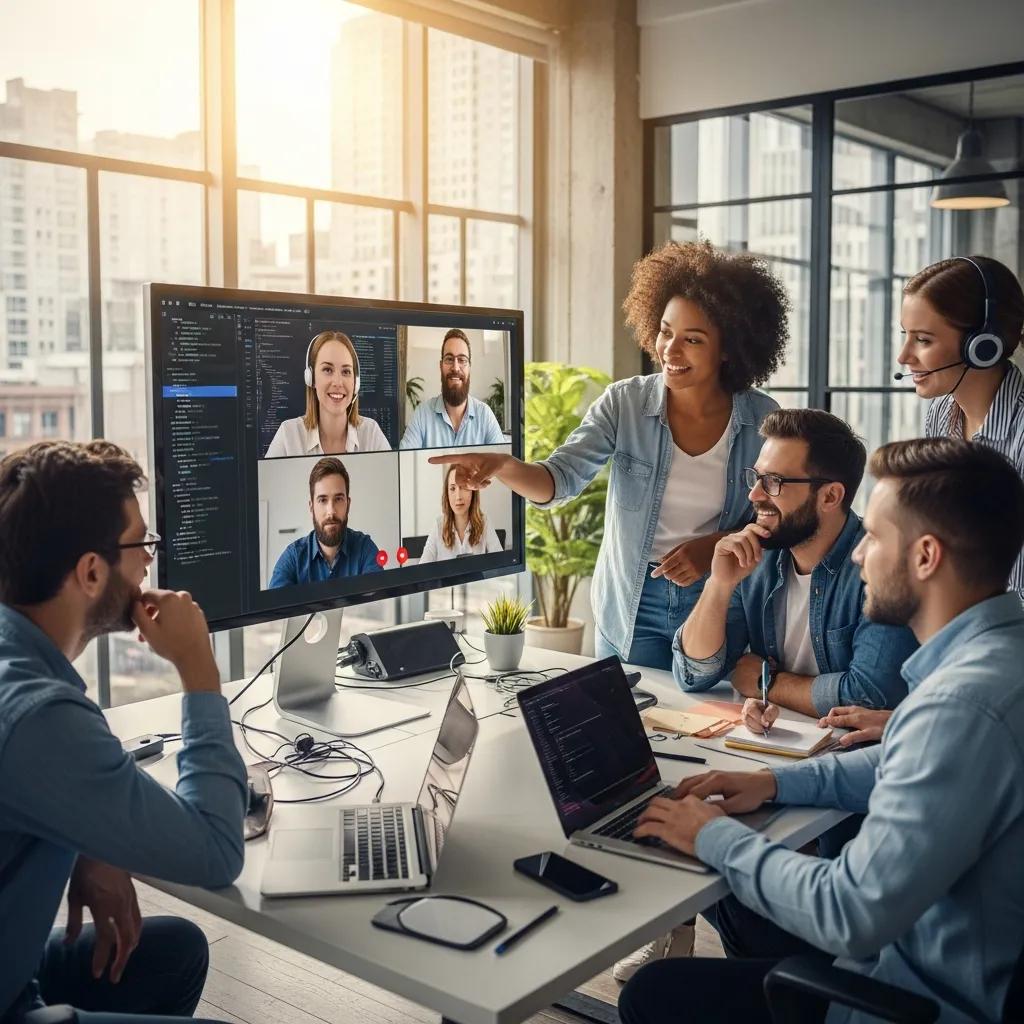
Future of Remote Work in the Software Industry: Trends, Challenges, and Solutions for 2025
Remote and hybrid work in the software industry refers to distributed development and collaboration models where teams blend office time with remote contributions, and 2025 marks a pivotal phase as AI, cloud tooling, and new policies converge to reshape workflows. This article explains which trends are accelerating change, the operational and security challenges teams encounter, and practical solutions software companies can adopt to maintain velocity and quality. Readers will learn the dominant trends for 2025, common productivity and cybersecurity pitfalls, the technology stack that enables distributed software work, and actionable best practices for hybrid operations. The piece also examines Google’s hybrid approach and Workspace capabilities as a case study that illustrates enterprise-grade tooling, AI assistance, and security patterns relevant to distributed engineering teams. Throughout, the focus is on developer-centric guidance — from code collaboration and CI/CD to cultural rituals and outcome-based performance — so engineering leaders and remote-first teams can make informed choices. The sections that follow unpack trends, challenges, enabling tools, optimization tactics, Google’s experience, and future innovations beyond 2025.
What Are the Key Remote Work Trends in the Software Industry for 2025?
Remote work trends in 2025 center on hybrid-first operating models, broad AI adoption in developer workflows, globalized hiring, and early-stage adoption of immersive collaboration tools like VR/AR that supplement existing communication platforms. These trends arise because cloud infrastructure, more sophisticated collaboration suites, and AI assistants reduce friction for distributed teams and expand the talent pool beyond local geographies. The result is faster staffing cycles for specialized roles, more asynchronous workflows, and a premium on secure, integrated tooling that supports both synchronous design reviews and async documentation. The next paragraphs list the top trends and then offer a compact comparison table to show adoption attributes and expected impacts.
Below are the top trends shaping the remote work software industry in 2025:
- Hybrid-first operations: Companies balance in-office collaboration with remote flexibility to optimize deep work and team cohesion.
- AI-augmented development: AI tools are embedded in code review, testing, and documentation to boost developer productivity.
- Global talent pipelines: Remote hiring widens candidate pools and increases role diversity across time zones.
- Immersive collaboration emergence: VR/AR prototypes appear for design reviews and spatial whiteboarding in specialized workflows.
These trends together emphasize a shift from location-based productivity to capability-enabled outcomes, which leads into a comparison of their attributes and likely hiring impacts.
Different trends have distinct adoption characteristics and effects for software teams in 2025.
| Trend | Adoption Profile | Impact on Hiring & Outcomes |
|---|---|---|
| Hybrid-first operations | Widespread among large and mid-size firms | Increases retention, requires flexible scheduling policies |
| AI-augmented development | Rapid uptake in tooling and assistants | Shortens review cycles, increases demand for AI-literate engineers |
| Global talent pipelines | High adoption for niche roles | Greater role diversity, need for async collaboration skills |
| Immersive collaboration (VR/AR) | Early adoption in design-heavy teams | Enhances certain interactions, limited by hardware availability |
This table clarifies how each trend translates into organizational change and sets the stage for how hybrid models and hiring patterns are reshaping company practices in the next subsection.
How Are Hybrid Work Models Shaping Software Companies?
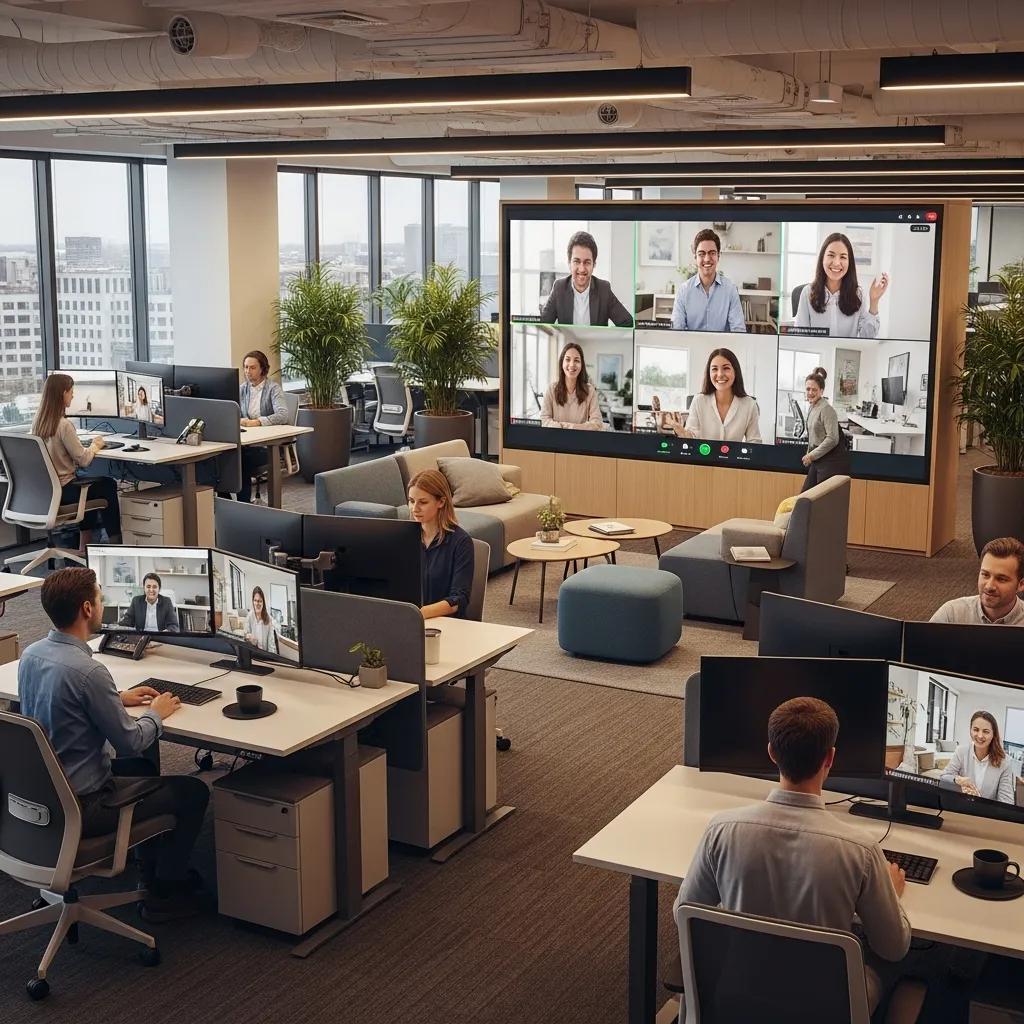
Hybrid work models for software companies describe structured combinations of in-office and remote time designed to preserve team cohesion while enabling distributed work. Organizations adopt variants such as fixed in-office days, role-based office presence, or remote-first approaches with optional hubs, and these choices change meeting cadences, onboarding flows, and workspace planning.
The primary benefit is access to broader talent while retaining moments of synchronous collaboration that accelerate design alignment and complex problem solving. Companies must therefore redesign rituals, schedule predictable overlap windows, and invest in documentation norms to ensure remote contributors are included. Understanding these model types leads directly to examining which remote IT roles are most sought after in 2025.
Which Remote IT Jobs Are Most In-Demand in 2025?
Demand in 2025 concentrates on roles that sustain cloud-native operations, security, and AI-driven product features, including software engineers, DevOps engineers, cloud architects, data scientists, and cybersecurity analysts. These roles support distributed systems, continuous integration and deployment, and the secure handling of data across remote endpoints, driving prioritized hiring in cloud and automation skillsets. Employers increasingly value candidates capable of async communication, infrastructure-as-code, and familiarity with cloud development environments and DevOps toolchains. Hiring trends therefore favor engineers who can both write production-quality code and operate robust pipelines for remote delivery, which frames the industry’s move toward tooling and practices that support these responsibilities.
What Are the Main Challenges of Remote Software Development?
Remote software development brings clear advantages but also introduces persistent challenges in coordination, developer well-being, security posture, and maintaining code and deployment quality across distributed teams. Communication friction and misaligned expectations are common when teams rely heavily on async channels without shared norms or clear documentation. These operational gaps can cascade into slower feature cycles or increased defects if code review and CI/CD governance are not strictly maintained. The next paragraphs analyze productivity and well-being impacts and enumerate cybersecurity risks that require targeted controls.
- Communication friction: Asynchronous handoffs and time-zone gaps can delay decision-making without clear protocols.
- Well-being and burnout: Blurred work-life boundaries increase the risk of fatigue and turnover if not actively managed.
- Security and compliance complexity: Distributed endpoints and cloud services expand attack surface and governance needs.
Addressing these challenges requires combining policy, tooling, and cultural practices to maintain velocity and safety for remote engineering teams.
Below is a concise comparison of core challenge areas and mitigation focus.
| Challenge Area | Key Risk | Mitigation Priority |
|---|---|---|
| Communication | Async gaps, lost context | Documentation standards, overlap windows |
| Well-being | Burnout, isolation | Manager training, rituals, workload limits |
| Security | Unsecured endpoints, misconfig | MFA, device management, zero-trust policies |
This table frames where to focus investments and paves the way to concrete tactics that improve productivity, culture, and security in remote software development.
How Does Remote Work Impact Software Developer Productivity and Well-being?
Remote work changes productivity dynamics: some teams report improved focus and fewer office interruptions, while others face coordination overhead and blurred boundaries that reduce sustainable output. Developers often gain deep-work time but may struggle with isolation and longer working hours when async signals are poorly managed. Practical mitigations include establishing clear overlap windows, synchronous rituals for complex planning, regular one-on-ones focused on workload and career development, and proactive well-being programs that normalize disconnecting. Implementing these tactics helps balance the productivity gains of remote work with the human support systems necessary to retain engineers, which leads into the security challenges that distributed teams must also address.
What Cybersecurity Risks Do Remote Software Teams Face?

Distributed development increases exposure to endpoint vulnerabilities, insecure home or public networks, and accidental data leakage via ad-hoc file sharing, creating a stronger need for centralized access control and policy enforcement. Recommended controls include enforcing multi-factor authentication, device management, and applying zero-trust principles to cloud resources and collaboration platforms to limit lateral movement. Equally important is integrating security into developer workflows — for example, automated dependency scanning, policy-as-code in CI/CD, and consistent secrets management. Paired with training and incident response processes, these measures reduce risk and support secure remote operations, leading naturally into the technology stack that enables those protections.
The rapid adoption of remote work has transformed organizational operations, introducing complex cybersecurity vulnerabilities that demand rigorous scholarly investigation.
Cybersecurity Risks of Remote Work: Vulnerabilities and Mitigation Strategies
The rapid adoption of remote work has transformed organizational operations, introducing complex cybersecurity vulnerabilities that demand rigorous scholarly investigation. This systematic literature review (SLR) critically examines cybersecurity risks in remote work environments by synthesizing findings from 20 peer-reviewed studies published between 2010 and 2024. Employing the PRISMA framework for transparency and rigor, the review integrates both qualitative and quantitative evidence using a convergent thematic synthesis approach. The analysis reveals a multifaceted threat landscape encompassing human factors, technical vulnerabilities, and organizational shortcomings. Key risks include phishing, social engineering, device misuse, insecure Wi-Fi and VPN usage, and policy non-compliance. Human behavior emerges as a predominant risk vector, exacerbated by limited training, misuse of remote autonomy, and blurred personal-professional boundaries. Organizational challenges—such as rushed digital transitions, shadow IT practices, and poor communication of cybersecurity protocols—further aggravate the threat matrix. The review also incorporates critical appraisal using MMAT, CASP, and JBI tools to ensure methodological soundness and bias mitigation. Synthesis tables distill findings into thematic clusters, providing actionable insights into risk categories and mitigation strategies. Proposed recommendations emphasize cybersecurity training, device and network hygiene, policy alignment, zero-trust frameworks, and continuous monitoring. This study contributes a comprehensive evidence base for scholars and practitioners navigating remote work cybersecurity. It advocates for adaptive, behavior-aware strategies to strengthen digital resilience, highlighting the need for future research on quantum, AR/VR, and blockchain technologies in remote settings. As remote work persists, cybersecurity must evolve accordingly to safeguard organizational integrity and continuity.
Investigating the cybersecurity risks of remote work: a systematic literature review of organizational vulnerabilities and mitigation strategies: M. Nizamuddin, 2025
Which Technologies and Tools Enable Effective Remote Software Work?
Effective remote software work depends on an integrated stack: collaboration suites, video conferencing, project management systems, cloud development environments, CI/CD pipelines, and AI-assisted tools that accelerate routine tasks. Collaboration platforms centralize planning and documentation while cloud IDEs and remote CI/CD let engineers run builds and tests without local environment constraints. Security and compliance tooling must be embedded into those workflows so policy enforcement becomes part of the developer pipeline rather than an extra step. The section that follows lists key categories of tools, presents a compact comparison table (including Workspace as a case study), and then explains how Workspace maps to software team workflows.
Key categories of tools supporting distributed software teams include:
- Collaboration suites for docs, chat, and meetings that centralize knowledge and enable async work.
- Project management and issue tracking systems that orchestrate work across time zones.
- Cloud dev environments and CI/CD pipelines that decouple development from local machines.
- AI-assisted code and documentation tools that reduce routine effort and accelerate reviews.
These tool categories interlock to provide consistent environments for code, tests, and communication, which is illustrated in the comparison table below.
| Tool Category | Primary Use Case | Representative Features |
|---|---|---|
| Collaboration Suites | Async docs, meetings, chat | Real-time editing, threaded chat, meeting recordings |
| Project Management | Work orchestration | Issue tracking, sprint planning, backlog prioritization |
| Cloud Dev & CI/CD | Build and test automation | Remote builds, automated tests, deployment pipelines |
| AI Assistants | Code review and docs | Summarization, code suggestions, test generation |
This comparison highlights how each class of tool contributes to reliable remote software delivery and introduces a focused case-study on Google Workspace’s role for software teams.
After the general comparison, consider Google Workspace as an illustrative solution used by many enterprises for seamless collaboration, AI-driven assistance, and enterprise-grade security. Google Workspace offers integrated apps such as Google Meet for video meetings, Google Chat for group communication, and collaborative document apps like Docs, Sheets, and Slides that map directly to engineering tasks: Docs for specifications and design documents, Sheets for lightweight tracking, Chat for rapid clarification, and Meet for design reviews and retrospectives. Workspace’s AI-assisted features help summarize documents and meetings, reducing time spent on administrative follow-ups and improving asynchronous handoffs. Enterprise security and compliance attributes from Workspace support access control and reduce risky ad-hoc sharing, making it practical for remote software teams that require both collaboration and governance. This practical mapping shows how a unified collaboration suite supports developer workflows while reinforcing security and AI augmentation.
How Does Google Workspace Support Remote Software Development Teams?
Google Workspace supports remote software teams through integrated apps that align to planning, code review, and documentation workflows, enabling stable knowledge capture and synchronous review sessions. Google Meet facilitates distributed design reviews and sprint demos, while Google Chat provides threaded context for feature discussions and quick decisions across time zones. Collaborative Docs, Sheets, and Slides let teams co-author specifications, design notes, and release plans with revision history to preserve context and reduce duplication. As noted in industry analyses, Workspace also includes AI assistance to summarize lengthy documents and meeting notes, streamlining follow-ups and reducing coordination overhead. These features combined with enterprise-grade security and accessibility create a consistent environment for remote teams to document, iterate, and ship software together.
What Role Does AI Play in Enhancing Remote Software Development?
AI enhances remote software development by automating mundane tasks, surfacing relevant code suggestions, generating test cases, and summarizing long meetings or documents to reduce cognitive load on engineers. In practice, AI can accelerate code review cycles by highlighting potential bugs or style inconsistencies and can create first-pass documentation drafts that subject-matter experts refine. This productivity lift shortens feedback loops and enables smaller, more focused synchronous sessions while increasing the effectiveness of asynchronous handoffs. However, governance and human oversight remain essential: teams must verify AI outputs, manage bias in suggestions, and maintain test-and-review standards to ensure automation improves quality rather than undermining it.
The integration of AI into development workflows is rapidly transforming the landscape of software engineering, creating new paradigms for team collaboration and productivity.
AI-Augmented Software Engineers: Next-Gen Development Teams
Managing AI-augmented workflows effectively is especially critical in.
AI-Augmented Software Engineers: The Next Generation of Development Teams
How Can Software Companies Optimize Hybrid and Remote Work Models?
Optimizing hybrid and remote work requires policy clarity, cultural rituals that include distributed contributors, outcome-based performance metrics, and technology choices that embed security and usability into everyday developer workflows. Policies should define overlap hours, expectations for in-office vs remote work, and role-specific requirements while preserving flexibility for individual circumstances. Cultural investments — such as structured onboarding, regular asynchronous retrospectives, and inclusive meeting norms — keep distributed teams aligned and reduce attrition. Finally, measuring outcomes with objective KPIs tied to product delivery helps shift evaluations from hours worked to value delivered. The next subsections list best practices and propose measurable implementation steps with expected outcomes.
Effective optimization centers on a set of practical best practices:
- Establish clear hybrid policies and predictable overlap windows to reduce coordination friction.
- Create onboarding flows and rituals that accelerate remote hires’ productivity and social integration.
- Use outcome-based KPIs (lead time, deployment frequency, incident response) to align performance with product goals.
Adopting these practices leads to measurable improvements in delivery predictability and team satisfaction, as shown in the following implementation table.
| Practice | Implementation Step | Expected Outcome / KPI |
|---|---|---|
| Asynchronous communication norms | Document templates and response SLAs | Reduced meeting load, faster async resolution |
| Outcome-based metrics | OKRs and feature lead-time tracking | Improved deployment frequency and predictability |
| Inclusive rituals | Virtual coffee, async retrospectives | Higher engagement and lower churn |
This table provides a clear mapping from practice to measurable outcome, and now the article examines concrete culture and performance tactics in more depth.
What Are Best Practices for Fostering a Strong Remote Software Team Culture?
Building a robust remote culture begins with structured onboarding that pairs newcomers with mentors, establishes documentation for codebases and workflows, and provides early, small-scope projects to build confidence. Regular rituals — such as asynchronous standup summaries, virtual social hours, and documented retrospectives — create predictable touchpoints for collaboration and recognition. Managers should prioritize psychological safety, encourage time-zone-aware scheduling, and use engagement surveys to detect early signs of burnout or disconnect. These steps accelerate team cohesion and set expectations for collaboration, which naturally supports clearer performance management practices described next.
How Can Performance and Outcomes Be Managed in Distributed Software Teams?
Performance management in distributed teams should emphasize outcomes rather than hours, using metrics like feature lead time, deployment frequency, mean time to recovery, and customer-impact indicators to assess effectiveness. Implementing lightweight dashboards and regular async reviews helps teams iterate on processes without imposing synchronous overhead. Code review quality, CI pass rates, and incident response timelines serve as engineering-specific KPIs that align individual contributions with product health. Coupled with regular feedback conversations and career development planning, these measures ensure distributed engineers are evaluated fairly on value delivered and growth potential.
How Is Google’s Hybrid Work Model Influencing the Future of Remote Software Work?
Google’s hybrid approach, which includes a common pattern of in-office days combined with remote flexibility and options for broader “work from anywhere” arrangements, serves as a prominent example for large software organizations balancing collaboration and flexibility. This policy influences industry expectations by demonstrating how scheduled co-location days can be paired with robust remote tooling to preserve both innovation and inclusion. Google’s internal needs have also driven product choices and features in collaboration tooling, emphasizing seamless integration among communication apps and support for AI-assisted workflows.
Organizations examining Google’s approach can draw lessons about predictable in-person collaboration, investment in integrated tooling that reduces switching costs, and the role of AI in easing asynchronous work burdens. These observations make the Google case study relevant for companies defining their own hybrid experiments and tooling roadmaps.
What Are Google Workspace’s Security Features for Remote Software Teams?
Workspace’s enterprise-grade security and compliance capabilities, as reported in industry analyses, include centralized access controls and features that limit risky ad-hoc sharing while enabling governed collaboration across distributed teams. These controls help mitigate common remote risks such as unsecured endpoints and uncontrolled file distribution by providing administrative policies for device management and access permissions. When paired with organization-level policies — like enforced multi-factor authentication and strict sharing rules — Workspace’s integration reduces friction for secure collaboration and lowers the chance of accidental data exposure. Combining product-level controls with developer-oriented security practices, such as secrets management and CI/CD scanning, gives remote software teams a layered defense.
How Does Google Integrate AI to Boost Remote Software Team Productivity?
Google’s collaboration tools incorporate AI assistance for tasks like summarizing documents and meetings, which reduces time spent on administrative follow-ups and helps teams maintain clear asynchronous context. These AI features automatically distill meeting notes and long documents into actionable items, enabling faster handoffs and fewer repetitive clarifications among distributed contributors. For software teams, document summarization and meeting highlights accelerate onboarding to discussions and help reviewers catch up quickly, thereby improving throughput. As with any AI augmentation, outputs require human validation and governance to ensure accuracy and alignment with engineering standards.
What Are the Future Innovations Impacting Remote Software Collaboration?
Looking beyond 2025, the most significant innovations likely involve deeper AI integration, more capable cloud-native development environments, and selective use of VR/AR for interactions that currently rely on rich spatial cues. AI will continue to automate repetitive parts of the development lifecycle — from test generation to more advanced code synthesis — while cloud IDEs and remote build systems reduce friction in contributor setup. Immersive tools will mature for niche use-cases like complex design reviews and collaborative whiteboarding where presence and spatial layout matter. The following bullets summarize short, medium, and long-range impacts to watch.
- AI maturation leads to stronger automation of testing, code suggestion, and documentation, streamlining reviews and reducing manual overhead.
- Cloud-native dev environments and improved CI/CD abstractions enable near-instant onboarding and reproducible builds across contributors.
- Targeted VR/AR adoption enhances interaction quality for design and architecture sessions while remaining limited by hardware and accessibility constraints.
These forecasts point toward a future where tooling largely removes environment friction and augments human creativity, and the last two subsections explore immersive collaboration and broader predictions beyond 2025.
How Will VR and AR Transform Remote Software Team Interaction?
VR and AR can provide richer social cues and spatial collaboration for specific developer tasks such as system architecture workshops, immersive whiteboarding, and product walkthroughs that benefit from shared spatial reasoning. Use-cases include virtual war rooms for incident response, collaborative diagrams in three-dimensional space, and proximity-based interactions that mimic informal office drop-bys. Benefits include improved engagement during complex problem solving and more natural hand-offs during design discussions, while limitations remain around hardware adoption, access equity, and the maturity of UX patterns. Realistic adoption will likely be incremental and task-specific rather than universal in the near term.
What Are the Predictions for Remote Work Trends Beyond 2025?
Predictions beyond 2025 include continued hybrid prevalence with more nuanced role-based policies, deeper AI integration across developer workflows, and the gradual emergence of specialized immersive collaboration tools for tasks that require richer interaction. Hiring will continue to globalize with more cross-border teams and emphasis on async communication skills, and platform consolidation may favor suites that combine collaboration, security, and AI assistance into cohesive developer experiences. These changes will push organizations to invest in governance, developer tooling, and cultural rituals that sustain long-term productivity in distributed environments.
- Continued hybrid prevalence will standardize predictable in-office collaboration days for cross-functional alignment.
- Greater AI integration will automate more testing and documentation tasks, increasing per-engineer throughput.
- Specialized immersive tools will emerge for high-value, interaction-heavy activities while mainstream collaboration remains document- and chat-centric.
These short forecasts reflect current trajectories and suggest practical areas for engineering leaders to prioritize investments in tooling, culture, and governance as remote work evolves.
Leave a Reply